
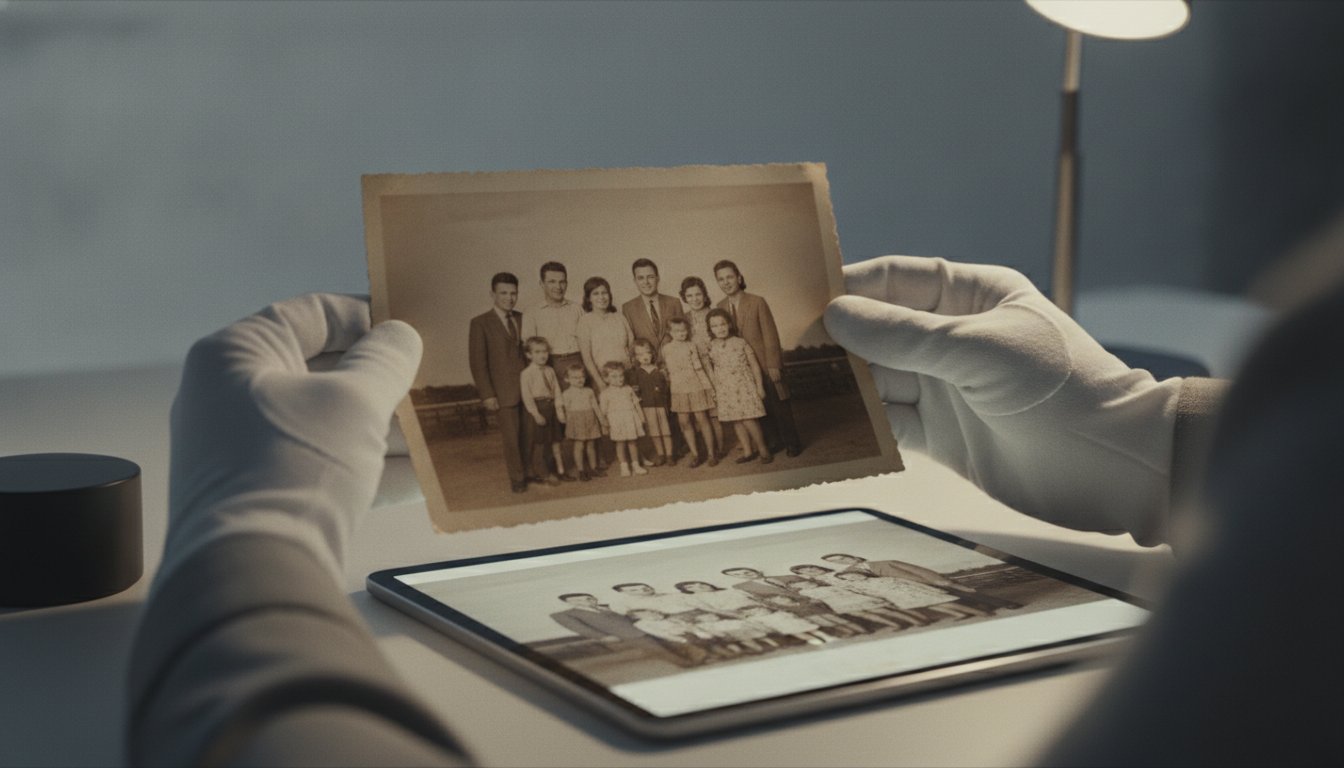
The most precious heirloom in your home isn’t the vintage silver or the hand-carved furniture; it’s the fragile, fading chemistry of your family’s photographic history. You recognize that these images represent more than mere paper. They are evidence, heritage, and heartbeat. When weighing the merits of professional photo scanning vs diy, the path toward preservation often feels clouded by technical complexity and the quiet fear of damaging irreplaceable originals. You deserve a digital archive that mirrors the significance of the moments it captures.
We believe your memories require a process that’s deliberate, precise, and protective. This article provides the definitive framework for choosing between the meticulous craft of professional archival services and the hands-on journey of a personal digitization project. You’ll discover how to secure museum-quality results, understand the true investment of your time, and find absolute peace of mind. We aim to transform your confusion over DPI and color depth into a confident strategy for legacy building.
We’ll examine the 2026 FADGI guidelines, explore the importance of new ISO standards for DNG files, and compare the archival depth of TIFF formats against common consumer shortcuts. This is your guide to choosing a solution that is as enduring as it is elegant.
Key Takeaways
- Identify the accelerating decay of analog media and learn why 2026 represents a critical juncture for establishing your family’s digital heritage.
- Calculate the “time-value” equation of your legacy to reveal the hidden labor and equipment costs associated with a home-based digitization project.
- Examine the definitive technical differences in professional photo scanning vs diy to ensure your archive meets modern museum-quality standards for resolution and color depth.
- Apply our bespoke decision checklist to determine if your collection’s volume and future printing needs justify an elite, professional-grade intervention.
- Discover a preservation philosophy that balances technical precision with artistic storytelling to protect, restore, and celebrate your most significant memories.
The Emotional and Technical Stakes of Digital Preservation
Digital preservation is the vital conduit connecting the milestones of our past with the aspirations of our future. It is a deliberate act of stewardship that ensures personal histories don’t merely exist, but thrive. When exploring the choice of digital preservation through the lens of professional photo scanning vs diy, we must acknowledge that we aren’t just managing files; we are safeguarding a narrative. This process is the bridge between a forgotten attic box and a living legacy that can be shared across the globe in an instant.
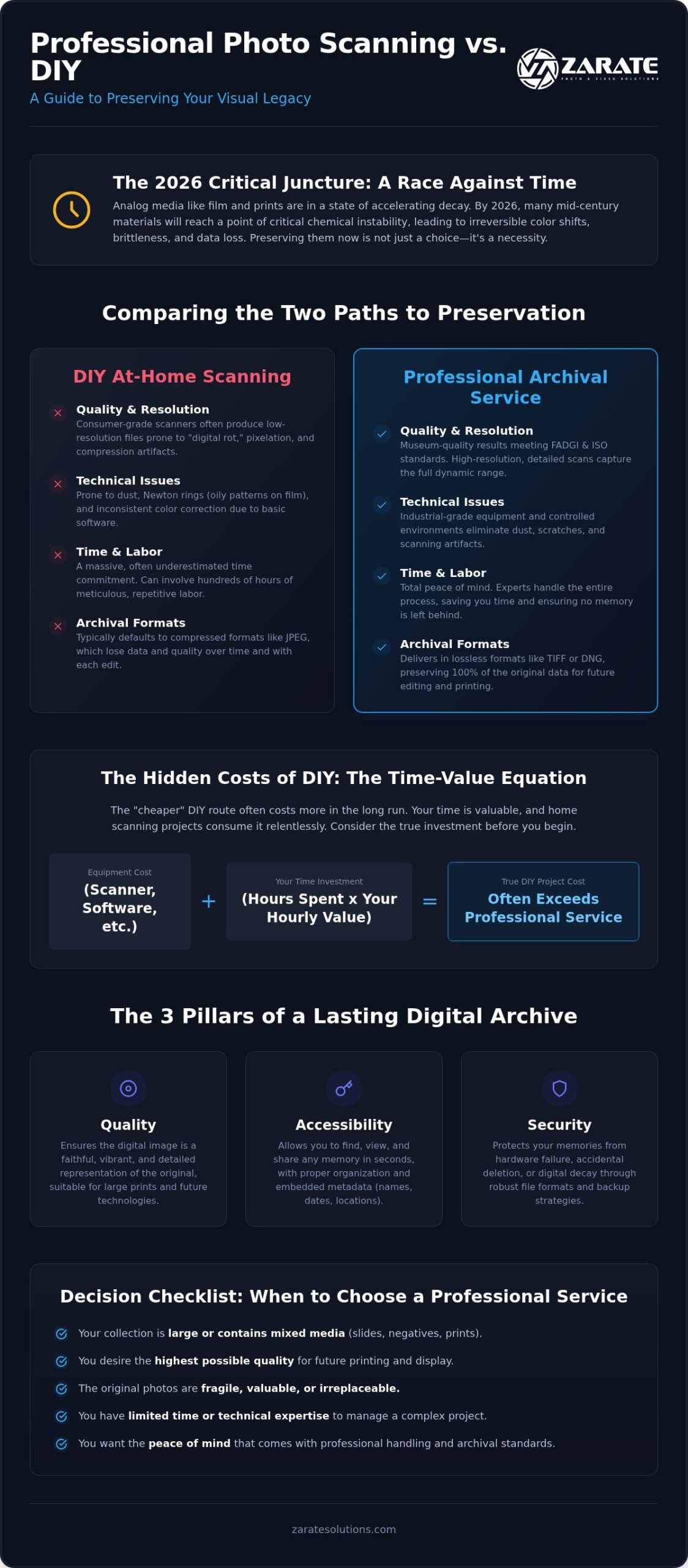
Physical media follows a relentless decay curve. By 2026, many analog film stocks and print papers from the mid-twentieth century are reaching a critical point of chemical instability. Color shifts, vinegar syndrome, and physical brittleness are no longer distant threats. They are active realities. Securing these images now is a race against time, chemistry, and environmental degradation. Waiting another decade could mean the difference between a successful restoration and the permanent loss of a family’s visual heritage.
A successful archive stands on three pillars: accessibility, security, and quality. Accessibility ensures you can find and share a memory in seconds. Security protects that memory from hardware failure or accidental deletion. Quality ensures the image remains a faithful, vibrant, and detailed representation of the original. This is where the “quick scan” mentality often fails. While a casual approach might settle for a cursory capture, a meticulous archivist seeks the deepest dynamic range and the most accurate color profile possible. The choice between professional photo scanning vs diy is ultimately a question of how you value the clarity of your own history.
Why Your Family Legacy Deserves More Than a Quick Scan
There is a profound psychological weight to rediscovered memories. Seeing a parent’s wedding or a child’s first steps in high definition can be an overwhelming emotional experience. However, low-quality DIY scans often suffer from “digital rot,” where heavy compression and low resolution leave the image pixelated and hollow. Your legacy deserves a curated digital narrative. It requires a transition from forgotten boxes of physical clutter to a structured archive that feels intentional, accessible, and profound.
The 2026 Standard for Digital Archives
The landscape of 2026 has introduced rigorous new benchmarks for archival excellence. We now look to the ISO 12234-4:2026 standard for Digital Negatives (DNG) and the updated Federal Agencies Digital Guidelines Initiative (FADGI) to define what true quality looks like. Professional standards prioritize high-bit depth and lossless formats like TIFF, ensuring that files remain readable, editable, and vibrant for decades. Metadata also plays a crucial role. It transforms an anonymous image into a searchable piece of history by embedding names, dates, and locations directly into the file’s digital DNA.
The Hidden Costs of the DIY Photo Scanning Path
Choosing the path of self-preservation often begins with a sense of romantic purpose. You imagine a quiet weekend spent rediscovering the faces of ancestors, but the reality of professional photo scanning vs diy quickly reveals a demanding landscape of technical hurdles and exhausting labor. This isn’t merely about owning a scanner; it’s about the meticulous, rhythmic, and often grueling work of digital stewardship. When you calculate the investment, you must look beyond the price of hardware to the silent depletion of your most finite resource: time.
The technical pitfalls of home scanning are subtle yet destructive. Without industrial-grade sensors, you’re likely to encounter Newton rings, those distracting, oily-looking interference patterns caused by film touching the scanner glass. Dust remains the archivist’s eternal enemy, requiring constant vigilance and surgical-grade cleaning. Furthermore, consumer software often lacks the sophisticated color profiles needed to correct the organic fading of mid-century prints. If the technical burden feels at odds with your vision, exploring a tailored analog-to-digital media conversion service can reclaim your schedule while elevating your archive to museum standards.
Investing in the Right Gear: Beyond the Basic Flatbed
A standard flatbed scanner, typically priced between $100 and $300, is often insufficient for a true legacy project. To achieve archival results for a large collection, you may find yourself looking at high-speed models like the Epson FastFoto FF-680W, which costs approximately $629.99 in 2026. Beyond the initial purchase, the “hidden” inventory adds up quickly:
- Specialized Software: Professional-grade licenses for SilverFast or Adobe Creative Cloud to handle complex color grading.
- Archival Cleaning Kits: Anti-static brushes, PEC-12 solvent, and microfiber cloths to prevent permanent scratches during handling.
- Data Infrastructure: High-capacity external drives and redundant cloud storage to secure the massive TIFF files generated by high-resolution scans.
The Labor of Love: Quantifying the Time Commitment
The time-value equation is where many DIY projects falter. Research indicates that scanning a modest collection of just 200 photos can require 15 to 20 hours of focused labor. This includes the physical preparation, the scan time itself, the manual file naming, and the essential post-processing. When scaled to a family collection of 1,000 or more images, the commitment transforms into a months-long endeavor. Most DIY projects eventually stall in the “shoe-box” phase because the sheer volume of individual frame attention becomes overwhelming. You’re not just scanning; you’re attempting to be the photographer, the technician, and the archivist all at once. The same challenge applies when families discover weathered reels alongside their prints — those fragile 8mm and Super 8 films demand an entirely separate skill set, making a professional 8mm film to digital conversion service an essential consideration for complete collection preservation.
Professional Photo Scanning: Restoration, Accuracy, and Peace of Mind
Choosing a professional service isn’t merely about convenience. It’s about access to industrial-grade technology that consumer hardware simply cannot replicate. While we’ve explored the labor-intensive nature of home projects, the technical chasm in professional photo scanning vs diy is most evident in the dynamic range of the sensors used. Professional equipment captures the subtle nuances in shadow and highlight that a standard flatbed ignores, ensuring every detail of a grandmother’s lace veil or the soft gradient of a sunset is preserved. This is a process of elevation, refinement, and absolute precision.
Artistic restoration goes far beyond a simple automated filter. It is a meticulous craft involving manual color grading, surgical digital repair, and a deep understanding of historical photographic chemistry. Experts analyze the specific way certain dyes fade over seventy years, applying corrections that feel organic rather than artificial. This level of care transforms a brittle, yellowed print into a vibrant heirloom that looks as though it were captured yesterday. It represents the intersection of technical mastery and emotional resonance.
The Science of Color and Clarity
Professional archives distinguish themselves through the rigorous application of science to visual memory. While many home projects settle for 300 DPI, archival standards frequently demand 600 PPI for prints and up to 4000 PPI for negatives to capture every silver halide crystal. This ensures your images are ready for large-scale heirloom printing, not just screen viewing. For those dealing with severely compromised originals, utilizing a specialized digital media recovery service allows for the salvage of images that have suffered from water damage, heat exposure, or chemical breakdown.
Security and Chain of Custody
The “fear of shipping” is a valid emotional hurdle for many families. Professional archivists address this through secure, tracked transit and rigorous internal chain-of-custody protocols. Your memories are never treated as bulk inventory. Instead, they are managed by a dedicated project manager who oversees the entire lifecycle of the project, from initial intake to final cloud integration. This “white glove” approach provides a level of security that DIY experimentation cannot match, especially when handling fragile, torn, or stuck-together originals that require an expert touch to separate without destruction. It is about trust, transparency, and the ultimate safety of your visual legacy.
The Definitive Decision Checklist: Is DIY or Professional Right for You?
Choosing the appropriate path for your family’s visual heritage is a quiet calculation of intent, resources, and respect. It’s a decision that rests at the intersection of your personal schedule and your long-term archival goals. When evaluating professional photo scanning vs diy, you aren’t simply choosing a service; you’re selecting the steward of your history. A methodical assessment of your collection’s volume, condition, and ultimate purpose will illuminate the most secure route forward.
While the allure of a hands-on project is significant, the reality of managing thousands of unique items often clashes with the technical demands of museum-quality preservation. If you find your collection demands a more sophisticated touch, we invite you to explore our bespoke media preservation solutions to ensure your legacy is handled with the gravity it deserves.
The 5-Point Legacy Assessment
Use this framework to determine if your archive requires the intervention of a meticulous professional or if it’s suitable for a personal home project:
- Volume: Do you have more than 500 unique items? Beyond this threshold, the time required for high-register scanning often exceeds 50 hours of labor.
- Condition: Are the originals showing signs of chemical decay, mold, or “silvering”? These fragile states require specialized handling that DIY equipment may exacerbate.
- Technical Proficiency: Do you possess the skills for advanced color grading and the patience for manual dust removal?
- Output Intent: Is the goal casual social media sharing or large-scale heirloom printing? Archival prints require the depth only industrial sensors provide.
- Infrastructure: Do you have the redundant storage systems necessary to protect high-bit-depth TIFF files?
Comparing the Outcomes: A Side-by-Side View
The visual difference between a smartphone app “scan” and a professional archival capture is profound. Consumer apps often use aggressive software sharpening and heavy compression, which strip away the organic texture of the original print. In contrast, a professional scan preserves the delicate grain and tonal transitions of the film. This technical superiority extends to the organizational structure of the final archive. A DIY project often results in a labyrinth of poorly named folders, while a professional archive is delivered as a curated, metadata-rich library that’s ready for immediate use.
The distinction is even more critical for bound memories. The long-term value of a photo album scanning service lies in its ability to capture the context of the page without damaging the binding. Professionals use non-destructive, overhead capture systems that respect the physical integrity of the album. This ensures that the story told by the layout remains as intact as the images themselves. It is the difference between a fleeting digital copy and a lasting, accessible heritage.
Entrusting Your Visual Legacy to Zarate Photo & Video Solutions
Zarate Photo & Video Solutions operates at the intersection of technical mastery, emotional resonance, and archival security. We don’t view your collection as a bulk project; we treat every frame as a bespoke piece of history that deserves individual attention. Our philosophy is rooted in the belief that your memories are not just data. They are a narrative that requires protection. Our process is methodical and deliberate. We clean, capture, and correct every image to ensure the chemical decay of the past doesn’t compromise the clarity of your future. Choosing professional photo scanning vs diy means choosing a partner who values the weight of your personal history as much as you do.
Our expertise extends beyond the printed page to encompass your entire media library. We provide comprehensive Analog-to-Digital Media Conversion for 35mm slides, fragile negatives, and vintage film reels. By integrating these diverse formats into a singular, searchable archive, we allow you to experience a lifetime of memories in one cohesive digital library. This unified approach secures your legacy against the instability of aging film while making it accessible for the next generation to discover and cherish. Families with aging reels can learn more about protecting those fragile recordings through our dedicated guide to 8mm film to digital conversion, which covers the full archival process from vinegar syndrome detection to high-definition digital output.
Customized Solutions for Complex Collections
Complex collections require a nuanced eye and a tailored strategy. We adapt our approach to meet the specific requirements of the media, whether we are preserving the vibrant joy of Quinceañera Photography, the timeless elegance of Wedding Photography, or the expansive records of corporate archives. We understand that a heritage collection demands a different metadata structure than a modern event. This commitment to customization ensures that your digital archive is not only high-quality but also intuitive and organized. If you’re ready to move beyond the limitations of home equipment, we invite you to consult with our team regarding your specific preservation needs.
A Commitment to Excellence and Security
Security is the cornerstone of our professional partnership. As authoritative experts in both creative photography and technical data recovery, we offer a level of protection that home-based experimentation cannot replicate. You’re not just hiring a technician; you are engaging a meticulous archivist who understands the science of 2026 archival standards. We provide the peace of mind that comes from knowing your originals are handled with white-glove care and returned to you alongside a museum-quality digital library. Your history is unique. It deserves a preservation process that is equally exceptional. Preserve your history with Zarate Photo & Video Solutions today.
Securing Your Place in History
Preserving a family legacy is a profound responsibility that demands more than a casual approach. As we have explored, the debate of professional photo scanning vs diy isn’t just about equipment; it’s about the technical precision required to arrest the decay of your most significant memories. You now understand the rigorous 2026 standards for archival fidelity and the immense time commitment required for a home-based project. Your history deserves a digital archive that’s as vibrant and enduring as the moments it captures.
Zarate Photo & Video Solutions serves as your bespoke storyteller and meticulous archivist. We combine deep expertise in technical media restoration with a traditionalist’s commitment to safeguarding the past. We treat every image as a unique narrative, ensuring that your heritage is protected with the highest register of craftsmanship and security. Don’t leave your visual history to chance or unfinished projects. Begin Your Legacy Preservation Project with Zarate Solutions and ensure your story remains clear for generations to come.
Frequently Asked Questions
What is the best way to digitize old family photos for long-term preservation?
The most effective method for long-term preservation involves using a high-resolution optical scanner to capture images in a lossless format such as TIFF or DNG. This approach adheres to the 2026 FADGI guidelines, which prioritize data fidelity and future-proof compatibility. By avoiding compressed formats like JPEG, you ensure that the digital file retains the maximum amount of visual information for future generations to enjoy, edit, and restore.
Is it cheaper to scan photos at home or use a professional service?
Determining the true cost requires a careful balance between upfront equipment expenses and the value of your personal time. While a basic flatbed may seem economical, the investment in high-speed hardware like the Epson FastFoto FF-680W and the 15 to 20 hours required to scan just 200 photos often tips the scale. For large collections, the efficiency of a professional service frequently provides a more cost-effective solution when your labor is factored into the total investment.
What DPI should I use when scanning old photos myself?
You should utilize a minimum of 600 DPI for standard photographic prints to ensure archival quality and allow for future enlargements. If you are digitizing slides or negatives, a much higher resolution of at least 2400 to 4800 DPI is necessary to capture the intricate details held within the smaller film surface. This technical precision is vital for maintaining the clarity, depth, and texture of the original analog media.
Can professional scanning services fix photos that are faded or damaged?
Professional archivists employ sophisticated color grading and digital repair techniques to breathe life back into faded or yellowed originals. These services go beyond automated filters to manually address chemical shifts, physical scratches, and environmental staining. This meticulous restoration process ensures that the final digital image reflects the vibrant reality of the moment it was captured, rather than the current state of the decaying paper.
How do I safely organize thousands of photos before scanning?
The safest way to prepare a large collection is to group photos by decade or significant life event using acid-free envelopes and archival-safe containers. Avoid using rubber bands, paper clips, or acidic adhesive tapes, as these can cause permanent chemical damage to the prints over time. Wearing lint-free cotton gloves during this organization phase prevents the transfer of skin oils, which can degrade the photographic emulsion during the scanning process.
What is the difference between a photo scanning app and a professional scan?
The primary difference lies in the sensor quality and the level of data compression used during the capture process. Smartphone apps rely on software interpolation and heavy JPEG compression, which often results in pixelation and lost detail in the shadow areas. A professional scan utilizes industrial-grade optical sensors to create a high-bit-depth, lossless file that mirrors the true dynamic range and organic grain of the original photograph.
Is it safe to mail my irreplaceable photos to a scanning service?
Mailing irreplaceable memories is a secure process when utilizing tracked shipping and established chain-of-custody protocols. Professional services prioritize the safety of your heritage by providing clear intake documentation and secure, climate-controlled handling once the materials arrive. This structured approach to professional photo scanning vs diy offers a level of security and accountability that often exceeds the risks of self-handling fragile or chemically unstable originals.
How long does it typically take to digitize a large family collection?
A DIY project involving 1,000 photos can easily span several months of dedicated weekend labor when you include cleaning, scanning, and file naming. In contrast, a professional archive is typically completed within a few weeks, depending on the complexity of the restoration required. This efficiency allows you to transition from a disorganized box of physical prints to a curated, cloud-integrated digital library in a fraction of the time.