

Your family’s history is currently locked away in a slow-motion state of decay, trapped behind the yellowing film of magnetic pages and brittle celluloid. It’s a heavy burden to realize that these irreplaceable moments are one humid afternoon or accidental spill away from vanishing forever. You likely feel the weight of this responsibility, yet the fear of losing originals in the mail or the confusion over technical specifications keeps those boxes tucked away in the attic. We understand that your memories aren’t just data; they’re the foundation of your personal narrative.
By choosing a professional photo album scanning service, you can finally bridge the gap between fragile physical archives and a secure, high-definition digital legacy. This guide will show you how to navigate the complexities of resolution, format, and delicate handling to ensure your assets are protected. We’ll examine the meticulous process of archival digitization, the importance of expert color correction for faded images, and the peace of mind that comes from a partner who treats your history with reverence, skill, and precision.
Key Takeaways
- Recognize the silent threat of chemical degradation in vintage albums and why the current window for preservation is closing.
- Distinguish between simple resolution and true archival quality by understanding how professional equipment extracts deeper data from slides and negatives.
- Identify the security protocols and artistic advantages that a boutique photo album scanning service provides over mass-market mail-in kits.
- Streamline your digitization project with strategic curation techniques that prioritize your most significant family milestones.
- Elevate your digital archive from a simple collection of files to a curated legacy through a blend of technical precision and artistic storytelling.
The Imperative of Preservation: Why a Photo Album Scanning Service is Essential Now
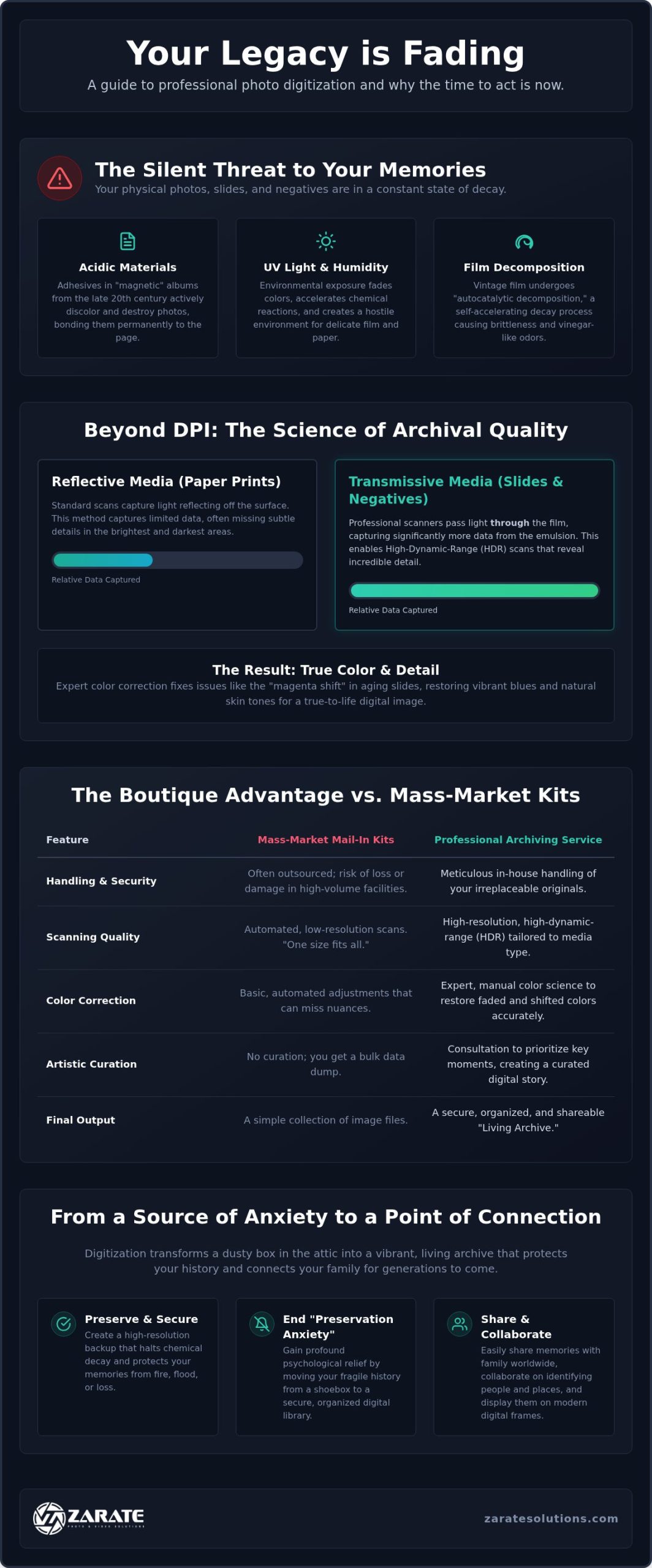
Time is a relentless thief. While we often view our family albums as permanent fixtures of the home, they are actually in a state of constant, quiet transition. The year 2026 represents a critical threshold for 20th-century analog media, as the chemical stability of color prints and film reaches a documented tipping point. Utilizing a professional photo album scanning service is no longer a luxury for the sentimental; it’s a necessary intervention to halt the inevitable erasure of your family’s visual history. This process requires a blend of reverence, skill, and precision to ensure that the transition from physical to digital is seamless and secure.
The physical artifacts of our lives are remarkably fragile. Most families possess a collection of magnetic or adhesive albums from the late 20th century, unaware that these storage methods are actively destroying the images they were meant to protect. The chemicals in these adhesives are often acidic. They migrate into the paper, discolor the dyes, and eventually bond the photo to the page with a grip that makes manual removal nearly impossible. There is a fundamental difference between digitizing for a quick social media post and archiving for the next century. An archival scan captures the depth, the texture, and the true color profile of the original, ensuring the files remain viable for high-resolution printing long after the physical originals have faded into obscurity.
Understanding the Risks of Analog Decay
Acidity is only one facet of the danger. Environmental factors like UV light and fluctuating humidity create a hostile environment for analog media. In the context of vintage film, autocatalytic decomposition is a self-sustaining chemical reaction where the degradation products of the film base actually accelerate further decay, leading to irreversible brittleness and vinegar-like odors. If your collection also includes home movie reels, a professional 8mm film to digital conversion service can rescue those flickering memories from the same chemical fate before vinegar syndrome renders them unrecoverable. Modern Image scanner technology provides the high-fidelity capture needed to freeze these images in time before the chemistry of the past overrides the beauty of the moment.
Digital Accessibility: Bringing History to the Modern Screen
Technical Excellence in Digitization: How to Digitize Slides and Negatives Professionally
True archival quality is a symphony of resolution, color accuracy, and dynamic range. While many believe that “DPI” is the sole metric of a high-end scan, it’s actually only half the story. Dots per inch measures the density of information, but it doesn’t account for the clarity, the depth, or the tonal precision of the final image. A premium photo album scanning service must look beyond simple numbers to capture the actual texture and soul of the original media. This is especially true when moving from paper prints to transmissive media like slides and negatives, which require a far more sophisticated approach to light and optics.
The physics of light dictates that slides and negatives hold significantly more data than paper prints. A print is a reflective medium; it only displays the information that bounces off its surface. In contrast, slides and negatives are transmissive, allowing a scanner to pass light through the emulsion to capture layers of detail hidden in the highlights and shadows. This allows for high-dynamic-range (HDR) scanning, a process that preserves the subtle nuances of a sunset or the fine details of a wedding dress that a standard scan would simply blow out. Correcting the “magenta shift” common in aging 35mm slides requires a deep understanding of color science, ensuring that the vibrant blues and natural skin tones of the original moment are faithfully restored.
The Nuance of Slide and Negative Conversion
Different formats demand different expertise. Whether you’re dealing with standard 35mm, the tiny frames of 110 film, or the expansive detail of medium format negatives, each requires specific calibration and handling. Professional negative scanning produces better results than print scanning because it captures the original source data before it was compressed and limited by the narrow tonal range of photographic paper. To achieve a pristine finish, we utilize Digital ICE technology for automated dust removal alongside meticulous manual restoration for stubborn scratches, following the preservation guidelines from the Library of Congress to ensure every asset is treated with professional care.
Resolution and File Formats for the Future
Choosing the right file format is essential for long-term accessibility. While JPEGs are excellent for sharing on social media, TIFF files serve as the master archival copies, preserving every bit of data without compression. We prioritize 48-bit color scanning as the professional benchmark, providing billions of possible colors to ensure smooth gradients and lifelike depth. By embedding metadata tagging directly into the file, we ensure that dates, locations, and family names remain tethered to the image forever. For those ready to secure their history, exploring professional analog-to-digital media conversion is the first step toward a permanent digital legacy.
The Boutique Advantage: Comparing Professional Archiving to Standard Mail-In Kits
Choosing a photo album scanning service is a decision that balances convenience against the sanctity of your family history. While mass-market mail-in kits offer a seductive simplicity, they often operate on a factory model that prioritizes volume over individual artistry. In these high-volume environments, your irreplaceable memories are frequently fed through automated belt-scanners that apply generic color profiles to every image regardless of its unique needs. A boutique studio provides a stark contrast. We treat each collection as a unique archival project, ensuring that every frame receives the individual attention, meticulous grading, and technical rigor it deserves.
The difference lies in the details. A factory approach might overlook the subtle color shifts of a 1970s print, whereas a bespoke service tailors the scan to the specific era and chemistry of the media. This technical synergy is further enhanced when your archival project is integrated with a digital media recovery service. If your physical assets have already suffered from environmental damage or structural failure, professional recovery ensures that the data is not just captured, but saved. This level of comprehensive care is only possible through a consultation-based approach that understands the personal narrative behind the pixels.
Security and Chain of Custody
Security is the foundation of trust. Professional studios prioritize a “white glove” handling protocol, avoiding the mechanical risks associated with the automated machinery used by mega-labs. When you work with a specialized media partner, your heirlooms never leave the hands of a trained archivist. Our background as a professional corporate event photographer informs our strict technical standards and organizational discipline. We apply the same level of precision required by high-stakes commercial clients to your personal family archives, maintaining a secure and transparent chain of custody from the moment we receive your box to the final digital delivery.
Artistic Restoration and Color Correction
True restoration requires a human eye. While AI-driven tools can offer a baseline of clarity, they often struggle with the nuance of skin tones and natural landscapes. We follow Library of Congress guidelines on photo preservation to ensure our manual restoration techniques remain faithful to the original moment. The “Zarate Touch” involves a careful balance of removing age-related defects while preserving the authentic character of the photograph. We don’t just scan; we preserve, restore, and elevate your visual legacy to ensure it looks as vibrant on a modern screen as it did the day it was captured.
Preparing Your Archives: A Step-by-Step Guide to Professional Digitization
Preparing your archives is a deliberate act of stewardship. It is the bridge between a cluttered box of memories and a curated digital legacy. While a professional photo album scanning service provides the technical expertise to preserve your history, the process begins with your personal narrative. By organizing your collection with intentionality, you ensure that the final digital archive reflects the true heart of your family’s journey. This preparation is not merely a logistical task; it’s an opportunity to rediscover the milestones that shaped your identity.
The first step is curation. You don’t need to scan every blurry landscape or duplicate print. Instead, focus on the “Legacy” photos: those rare, evocative images that capture the character of a person or the significance of an event. Once you’ve identified these high-priority assets, organize them by decade, family branch, or major life event. This structure provides a digital roadmap, allowing your archivist to apply meaningful naming conventions that will make your future library searchable, accessible, and intuitive for generations to come.
Pre-Scanning Organization
Handling fragile media requires a gentle touch and specialized materials. Use only non-damaging markers or acid-free sticky notes on the back of prints or on storage envelopes to provide context. If you encounter “mystery media,” such as slides in unusual metal mounts or negatives that appear brittle, set them aside for professional assessment. For those dealing with the precarious nature of 1970s magnetic photo albums, follow these safety steps before transport:
- Do not attempt to peel: If a photo feels bonded to the page, leave it. Forced removal often leads to permanent surface tearing.
- Interleave with care: Place a sheet of acid-free glassine paper between the album pages to prevent further chemical migration.
- Structural support: Secure the album between two pieces of rigid, archival-grade cardboard to prevent the spine from cracking.
- Moisture protection: Place the entire secured album into a clean, resealable bag to safeguard against environmental shifts during transit.
Defining Your Output Goals
Consider how you intend to interact with your history. While cloud storage offers unparalleled sharing capabilities, a physical USB backup provides a tangible master copy for your safe. We recommend the “3-2-1” backup rule: maintain three copies of your data, on two different media types, with at least one copy stored off-site. Your digital files can also serve as the foundation for modern heirlooms, such as high-end books designed in the style of customizable wedding photography packages. To begin the journey of safeguarding your past, you can reserve your archival consultation today and ensure your visual legacy remains vibrant and secure.
Beyond the Scan: Zarate Solutions’ Bespoke Approach to Media Preservation
At Zarate Solutions, our philosophy transcends the mechanical act of digitization. We view every slide, negative, and print as a piece of fine art that deserves to be handled with meticulous care. While mass-market retail partnerships often result in compressed files and lower resolutions, our boutique photo album scanning service is rooted in the intersection of technical data recovery and artistic visual storytelling. We don’t just create files; we safeguard the emotional weight of your personal history through a process that values quality over quantity.
Complex archives require more than a one-size-fits-all approach. Scrapbooks with layered ephemera, oversized panoramic prints, and fragile film strips each present unique challenges that automated systems cannot navigate. Many families also discover home movie reels alongside their photo collections, and our professional 8mm film to digital conversion service ensures those moving images receive the same archival rigor as every still photograph in your collection. We provide custom solutions tailored to the physical integrity of your media, ensuring that even the most delicate items are preserved without compromise. As your partner in preservation, we offer ongoing support to help you manage, organize, and expand your digital family archive as new discoveries come to light.
A Meticulous Archival Process
Our studio environment is a sanctuary for your memories. We maintain a controlled, dust-free space to ensure every capture is of the highest fidelity, free from the artifacts that plague high-volume labs. The process concludes with a personalized review, allowing you to verify that every frame meets our exacting standards. Because we possess professional data recovery capabilities, we are the safest choice for your irreplaceable files. This technical expertise provides a level of security that a standard photo album scanning service simply cannot match, ensuring your digital legacy is as durable as it is beautiful.
Starting Your Preservation Journey
Securing your history is a gift to your future self. To begin your media conversion project, we invite you to book a consultation where we can discuss the specific needs of your collection. During the intake and assessment phase, we evaluate the condition of your assets and define a preservation strategy that aligns with your goals. This methodical approach ensures that every detail is captured with precision and respect. Don’t wait for the next milestone event to realize the fragility of your physical archives. By taking action today, you ensure your legacy is protected, polished, and ready to be shared with the people who matter most.
Securing Your Visual History for the Next Generation
Your family’s narrative deserves more than a temporary existence in a deteriorating adhesive album. We have explored how a professional photo album scanning service acts as a vital safeguard against the chemical decay of vintage media, ensuring that the vibrancy of the past remains accessible for the future. By prioritizing technical excellence and studio-grade quality, you transform fragile physical artifacts into a resilient digital legacy that won’t fade with time. This transition is about more than just creating files; it’s about the security and peace of mind that comes from expert handling and meticulous curation.
You are the steward of your history. By integrating expert analog-to-digital conversion with professional data recovery, you ensure that every frame is captured with artistic reverence and technical precision. It’s time to move your memories from the shadows of storage into the light of a secure, shareable archive. Secure Your Family Legacy with Zarate Solutions’ Bespoke Conversion Services. Your past is a treasure, and together, we can ensure it remains a vibrant part of your family’s future for generations to come.
Preservation Insights: Frequently Asked Questions
Is it better to scan the whole album page or individual photos?
Scanning individual photos is the professional standard for a photo album scanning service. While capturing a full page preserves the original layout and handwritten notes, it severely limits the resolution available for each specific image. Individual scans allow for precise color grading, meticulous dust removal, and the ability to enlarge cherished moments without losing the clarity or depth of the original print.
Can you digitize slides that have significant mold or water damage?
Digitization is often possible even with mold or water damage through specialized manual cleaning and advanced digital restoration. We evaluate each slide to determine the stability of the emulsion before proceeding with any archival work. Our technical expertise in data recovery ensures that we can often salvage visual information that appears lost to the naked eye, restoring the narrative of your history.
How much resolution (DPI) do I actually need for old family photos?
For standard photographic prints, 600 DPI is the archival benchmark for most legacy collections. However, slides and negatives require significantly higher resolutions, typically between 2000 and 4000 DPI, to capture the dense information stored in the small film frame. This technical precision ensures your digital files remain crisp and detailed even when viewed on modern high-definition screens or printed in large formats.
What is the difference between a photo scanning service and a DIY home scanner?
A professional service utilizes high-dynamic-range (HDR) scanners and 48-bit color depth that far exceed the capabilities of consumer flatbeds. DIY scanners often struggle with shadow detail and lack the automated infrared channels used for professional scratch removal. Professional archiving provides a level of technical precision and artistic color correction that home equipment simply can’t replicate, ensuring a superior digital legacy.
How long does the professional digitization process typically take?
The timeline for professional digitization depends on the volume and condition of your media. A bespoke project usually spans two to four weeks, allowing for the individual attention and manual restoration required for high-end results. We prioritize the safety and integrity of your assets over the speed of a factory-style assembly line, ensuring each frame receives the reverence it deserves.
Will my original albums and negatives be returned to me safely?
Your physical assets are returned to you with the same level of meticulous care used during the scanning process. We maintain a secure chain of custody and use archival-grade packaging for the return journey to ensure your items arrive in their original condition. Preserving the physical artifacts is a core component of our commitment to your family’s complete visual history.
Can you convert old negatives if I no longer have the physical prints?
Negatives are the ideal source for digitization because they contain more raw data and dynamic range than a paper print. We can easily convert 35mm, 110, and medium format negatives into high-resolution digital positives. This professional photo album scanning service process often yields better color and detail than scanning a vintage print that may have already suffered from surface fading or chemical shifts.
What file formats should I request for long-term archival storage?
You should request uncompressed TIFF files for your master archival copies to ensure no data is lost during the conversion. These files preserve all the original information and are essential for future editing or high-quality printing. For daily use and sharing with family, we also provide high-quality JPEGs, which offer a perfect balance of visual clarity and manageable file sizes for modern devices.