

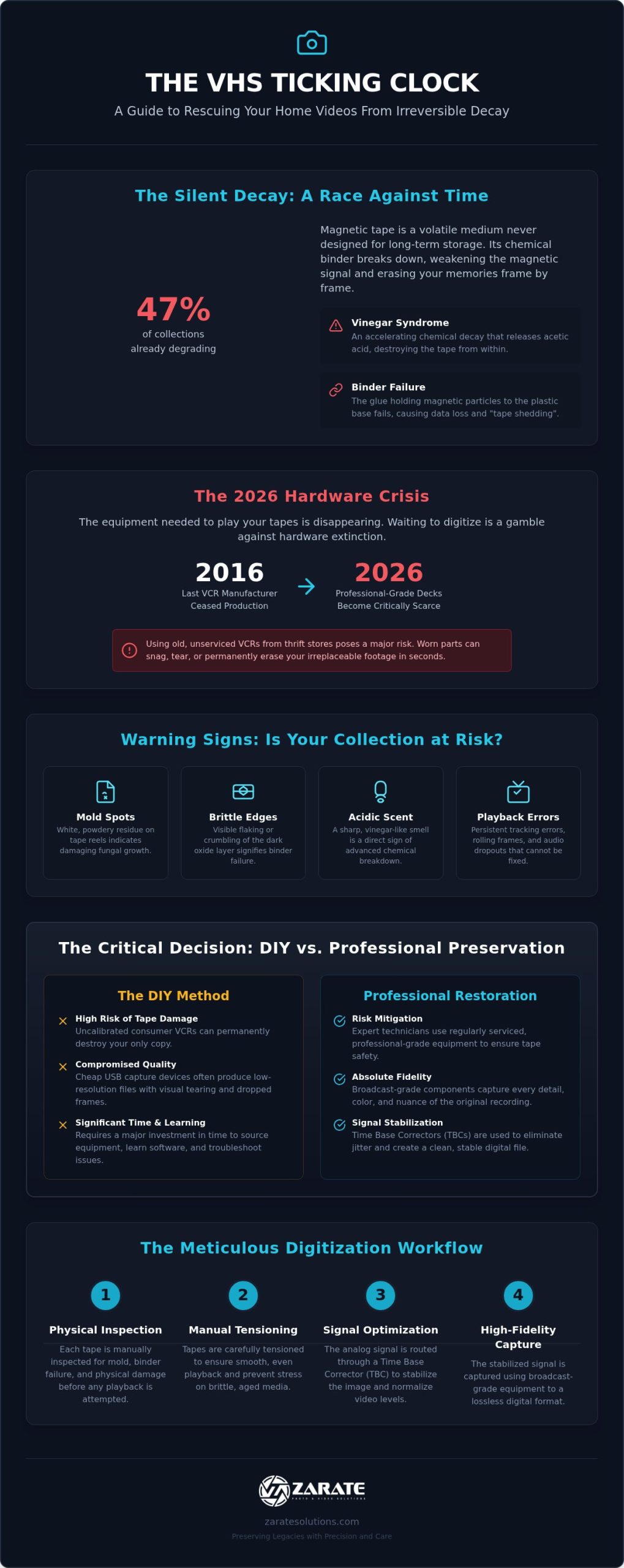
Nearly 47 percent of home VHS collections are already showing signs of degradation, a silent decay that threatens to erase decades of personal history. It is a heavy burden to realize that your most cherished milestones, those grainy but golden memories of weddings, birthdays, and first steps, are currently trapped on a fragile medium that was never meant to last forever.
You deserve a solution that honors the emotional weight of these moments, and learning how to convert vhs tapes to digital is the first step toward creating a permanent, high-fidelity archive. This preservation guide provides the technical clarity you need to navigate complex hardware requirements, master the professional digitization workflow, and select a partner capable of treating your legacy with the respect, precision, and artistry it demands. We will explore the meticulous steps required to transform your aging magnetic tapes into a secure, vivid, and accessible digital future.
Key Takeaways
- Recognize the chemical urgency of tape rot and magnetic decay to safeguard your personal history against the inevitable passage of time.
- Navigate the critical decision to convert vhs tapes to digital by weighing the technical complexity, time investment, and risks of DIY methods against professional preservation.
- Implement a meticulous, multi-step digitization workflow that prioritizes physical inspection, manual tensioning, and precise signal optimization.
- Secure the visual integrity of your archive by mastering native resolution standards, maintaining correct aspect ratios, and avoiding the pitfalls of artificial upscaling.
- Discover a bespoke approach to restoration that balances technical precision with a deep respect for the narrative, emotional, and historical significance of your media.
The Silent Decay: Why You Must Convert VHS Tapes to Digital Now
Time is the quietest thief of all. While we often view our home movie collections as permanent fixtures of the family archive, the physical reality is far more precarious. Magnetic tape is a volatile medium, composed of a delicate chemical binder that tethers iron oxide particles to a plastic base. As the years pass, this binder inevitably breaks down, causing the magnetic charge to weaken, the signal to fade, and the narrative of our lives to blur into static. To convert vhs tapes to digital is not merely a technical upgrade; it’s a necessary act of rescue for a legacy that is currently dissolving in real-time.
The history of the VHS format reveals a technology designed for convenience rather than centuries of storage. Most tapes recorded in the 1980s and 90s have already surpassed their intended lifespans, reaching the critical 25-year shelf life limit. We now face the reality of Vinegar Syndrome, a specific form of chemical deterioration where the acetate base releases acetic acid. This process is autocatalytic, meaning that once the decay begins, it accelerates, effectively destroying the tape from the inside out. Without intervention, these physical artifacts will soon become unplayable relics of a lost era.
Identifying the Signs of Tape Degradation
A meticulous archivist begins with a sensory inspection. You can often diagnose the health of your collection before a single frame is played. Look for white, powdery mold spots on the edges of the tape reels, which indicate fungal growth caused by improper humidity. Brittle edges and visible flaking of the dark oxide layer are signs that the binder has failed. If you open a tape case and notice a sharp, acidic scent, you are smelling the literal breakdown of the plastic. During playback, these issues manifest as persistent tracking errors, rolling frames, and frequent audio dropouts that no amount of manual adjustment can fix.
The 2026 Hardware Crisis
The danger to your memories isn’t limited to the tapes themselves; the machines required to play them are vanishing. Since the final VCR manufacturer, Funai Electric, ceased production in July 2016, the world has relied on a dwindling supply of second-hand hardware. By 2026, finding a professional-grade deck that hasn’t been compromised by decades of wear is an arduous task. It’s tempting to use a thrift store find for a DIY project, but these unserviced machines often possess misaligned rollers, worn belts, or abrasive heads that can snag, tear, or erase your most precious footage in seconds. Professional preservation requires more than just a working player. It demands the use of a Time Base Corrector (TBC) to stabilize the signal, ensuring the resulting digital file is fluid, consistent, and clear.
Evaluating Your Archive: Professional Restoration vs. DIY Methods
Choosing how to convert vhs tapes to digital requires a delicate balance between technical curiosity and emotional significance. If you’re preserving a rare family wedding, a child’s first steps, or a final message from a loved one, the stakes are absolute. These are the moments where quality is not a luxury but a requirement. Conversely, digitizing a generic television broadcast or a replaceable commercial tape might be a suitable weekend project for a hobbyist with time to spare. The decision rests on the value you place on the narrative, the clarity, and the longevity of the final archive.
DIY is rarely as simple or as inexpensive as it first appears. It demands a significant investment in time, patience, and specialized equipment. Beyond the initial purchase of hardware, you must account for the steep learning curve of capture software and the very real risk of mechanical failure. A single misaligned roller in a budget VCR can permanently score the magnetic surface of your only copy, turning a cherished memory into an unrecoverable loss. Professional services mitigate these risks by using equipment that is regularly serviced, calibrated, and monitored by expert technicians.
Quality benchmarks vary wildly across the industry. Mass-market USB capture dongles often sacrifice frame rate, color depth, and signal stability to maintain a lower price point. These consumer-grade devices frequently struggle with visual tearing or dropped frames when the analog signal is anything less than perfect. Professional capture stations utilize high-bandwidth interfaces and broadcast-grade components to ensure every nuance of the original recording is captured with absolute fidelity, maintaining the texture and warmth of the analog original.
The DIY Hardware Checklist for 2026
- A high-end VCR featuring S-Video output to ensure superior luminance and chrominance separation.
- A dedicated analog-to-digital converter, opting for a high-performance external interface over budget alternatives.
- A modern computer equipped with sufficient processing power and high-speed storage to handle large, uncompressed video streams without stuttering.
The Professional Advantage: Beyond the Transfer
True preservation involves signal cleaning, digital noise reduction, and meticulous color correction to breathe life back into faded footage. Professional archivists possess the specialized tools required to perform physical tape repair and splicing for cassettes that have snapped or jammed over decades of storage. If your archive contains irreplaceable history, exploring Zarate’s media preservation service provides the technical bridge needed to restore, refine, and protect your family’s visual legacy with the security, quality, and craftsmanship it deserves.
The Meticulous Process: A Step-by-Step Digitization Workflow
To convert vhs tapes to digital with professional integrity is a slow, deliberate journey. It requires you to act as both a technical operator and a vigilant guardian of history. This workflow ensures that every frame is treated with the gravity it deserves, moving from physical preparation to final digital encoding with absolute precision. By following a structured methodology, you protect the tape from mechanical stress while maximizing the visual fidelity of the transfer.
The process begins with a tactile inspection. You must manually check the reel tension and gently rotate the spools to ensure the tape hasn’t become stuck to the casing. Once the physical housing is secure, the VCR heads must be cleaned using high-purity isopropyl alcohol and lint-free chamois swabs to prevent signal interference. After connecting your playback deck to a dedicated capture station, you’ll monitor the transfer in real-time, adjusting the tracking to align the heads with the original recording machine’s unique path. The final stage involves post-capture refinement, where the raw data is trimmed, stabilized, and encoded into a format that balances quality with longevity.
Configuring Your Capture Software
Technical accuracy starts with the right settings. You should capture at a resolution of 720×480 for NTSC tapes; this is the honest resolution of the format, and anything higher is merely artificial upscaling that adds no real detail. For the codec, utilize ProRes 422 if you intend to archive a master copy, or H.264 for a versatile file that’s easy to share. Always set your audio sampling to 48kHz to ensure modern playback compatibility and sonic depth.
Real-Time Monitoring and Troubleshooting
Vigilance is your best tool during the capture phase. You’ll likely encounter interlace artifacts, those jagged “combing” lines seen during fast motion, which require professional deinterlacing filters to resolve for modern screens. Tracking must be adjusted for every tape to minimize the “snow” at the bottom of the frame. Managing file sizes is equally vital; a high-quality capture can be large, so you must balance bitrate with your available storage capacity to maintain a sustainable archive.
Technical Fidelity: Optimizing Resolution, Aspect Ratio, and Bitrate
Preserving the past requires more than a simple file transfer; it demands a commitment to technical authenticity. When you convert vhs tapes to digital, the goal is to mirror the original experience, not to distort it through modern filters. This involves a precise understanding of the technical parameters that define the analog signal, ensuring that every frame remains vivid, accurate, and evocative. Fidelity is a choice. It’s the difference between a blurry digital copy and a vibrant, stable, and true restoration of your history.
A common misconception in media restoration is the pursuit of “4K VHS.” Because the native resolution of a standard VHS tape is significantly lower than modern high-definition standards, artificial upscaling provides no additional detail. Instead, it introduces digital artifacts, blurring, and a synthetic texture that robs the footage of its organic charm. True fidelity is found in capturing the native signal at its honest resolution, using high bitrates to ensure that the natural grain and motion of the tape are preserved without the blocky compression often seen in mass-market transfers.
Aspect Ratio and the ‘Black Bar’ Debate
The classic 4:3 aspect ratio is an essential component of the analog aesthetic. Stretching this footage to fit a modern 16:9 widescreen display results in distorted faces, squashed landscapes, and a total loss of visual integrity. Pillarboxing, the inclusion of black bars on the sides of the frame, is the only way to maintain original proportions. For a bespoke touch, some archivists use software to add descriptive titles or subtle textures to these borders, turning a technical necessity into a storytelling opportunity. Avoid cropping at all costs, as it permanently discards visual information from the top and bottom of your memories.
Long-Term Digital Storage Strategies
Digitization is the beginning of the preservation journey, not the end. To secure your legacy, you must adopt the “3-2-1” backup rule: maintain three copies of your data, stored on two different formats, with one copy kept in an off-site location. While cloud storage offers unparalleled accessibility, it should be complemented by physical backups on external SSDs or archival M-Discs, which are engineered to resist environmental decay for centuries. For those seeking to unify their entire family archive, our professional photo scanning vs DIY guide offers additional insights into maintaining a high-fidelity digital library. If you’re ready to secure your history with archival-grade precision, explore our analog-to-digital media conversion services to begin your bespoke preservation project.
Bespoke Preservation: The Zarate Approach to Media Restoration
At Zarate Photo & Video Solutions, we believe that your media is more than just data; it is a vital, living narrative of your family’s history. When you choose to convert vhs tapes to digital with us, you aren’t engaging a mass-market factory, but a meticulous archivist dedicated to technical precision. We treat every cassette as a unique historical artifact, examining, cleaning, and restoring it with the gravity it deserves. Our approach balances state-of-the-art capture technology with a deep respect for the emotional resonance found in every frame. It’s a commitment to ensuring that the texture of your memories remains as vivid today as the moment they were recorded.
We understand that the transition from a physical past to a digital future can feel daunting. Our role is to act as your high-end guide, providing a seamless bridge that prioritizes visual quality and archival security. By focusing on customization and artistic excellence, we move beyond simple transfers to provide a premium, tailored solution. This process is steady, reassuring, and professional, leading you from the uncertainty of aging magnetic tape to the quiet confidence of a permanent digital archive.
Comprehensive Media Solutions
A complete digital archive is rarely limited to a single medium. We offer an integrated suite of services designed to unify your entire visual legacy, from magnetic tape to physical print. By pairing your video conversion with our photo album scanning services, you create a cohesive, searchable, and secure family history. Our expertise extends across the technical spectrum, allowing us to preserve diverse formats like legacy 8mm film reels with the same archival quality. Additionally, our national-scale data recovery expertise ensures that even the most fragile or damaged media receives the highest level of technical care and professional oversight.
Begin Your Preservation Journey
Starting your preservation journey is a simple, secure, and professional process. We recommend gathering your collection, noting any specific tapes of high priority, and ensuring they’re stored in a cool, dry environment until they reach our hands. During your Zarate consultation, we discuss your unique requirements, assess the condition of your media, and outline a tailored restoration plan. This intake process provides you with absolute peace of mind, knowing that your past is being safeguarded by innovators who value quality, craftsmanship, and security above all else.
The window for preservation is closing as physical media continues its silent decay. Don’t wait for a chemical failure to decide the fate of your most cherished milestones. By choosing a partner who understands the bridge between analog history and modern digital accessibility, you ensure that your story remains vivid, accessible, and permanent. Secure your legacy today through an expert consultation and transform your aging tapes into a high-fidelity archive that will endure for generations.
Preserving the Narrative of Your Past
The journey from a fragile magnetic strip to a secure digital archive is an act of profound respect for your personal history. We’ve explored the chemical urgency of tape rot and the meticulous technical standards required to maintain visual fidelity. You now understand that true preservation isn’t found in artificial upscaling; it’s found in the precise, frame-by-frame restoration of the original analog signal.
Choosing to convert vhs tapes to digital is an investment in the longevity of your family’s history. While DIY methods offer a path for hobbyists, high-stakes memories require the steady hand of a meticulous archivist. With expert technical media restoration and archival-grade digitization equipment, you can ensure your most cherished milestones remain vivid for generations to come. As a trusted national service for personal milestones, we’re here to bridge the gap between your analog past and a secure digital future. Secure Your Family Legacy with Zarate’s Bespoke Preservation Services and take the first step toward a permanent, high-fidelity archive. Your story is ready to be rediscovered.
Frequently Asked Questions
How much does it cost to convert VHS tapes to digital in 2026?
Pricing for professional media conversion varies based on the size of the collection, the technical condition of the tapes, and the level of restoration required. While mass-market services offer flat rates, a bespoke archivist provides a tailored quote that reflects the meticulous care and specialized hardware used to safeguard your history. This investment ensures your milestones are preserved with archival-grade precision rather than being subjected to generic, high-volume processing.
Can I convert VHS tapes to digital at home without a VCR?
No, you cannot convert these tapes without a functioning playback deck. Because the data is stored as a magnetic analog signal, a physical VCR head must read the tape to translate it into a digital stream. While some standalone converters exist, they still require an internal or external mechanism to physically rotate the reels and scan the magnetic particles. Attempting a transfer without a high-quality, serviced player often results in unrecoverable signal loss.
What is the best digital format for long-term VHS preservation?
The industry standard for archival-grade preservation is an uncompressed or high-bitrate format like Apple ProRes 422. This codec maintains the original signal’s integrity, color depth, and texture without introducing compression artifacts. For daily viewing and sharing, H.264 is the preferred choice due to its universal compatibility and efficient file size. We recommend maintaining a master archival file alongside a versatile viewing copy to ensure your legacy remains both secure and accessible.
Will my digital files look better than the original VHS tape?
Digital files can appear significantly cleaner, more stable, and more vibrant than the raw analog playback. Through professional signal cleaning, digital noise reduction, and meticulous color correction, we can breathe new life into faded footage. However, the goal is to enhance the existing signal rather than invent detail that wasn’t there. When you convert vhs tapes to digital, the result is a high-fidelity restoration that honors the organic warmth of the original recording.
How long does a typical VHS tape last before it becomes unplayable?
Most magnetic tapes have a functional lifespan of approximately 25 years. Tapes recorded in the 1980s and 90s have already reached a critical threshold where binder hydrolysis and magnetic decay begin to compromise the signal. Environmental factors like humidity, temperature fluctuations, and dust can accelerate this timeline. Once the chemical breakdown begins, the risk of tape rot makes immediate digitization the only viable path to saving your family’s visual narrative.
Can you recover video from a snapped or broken VHS tape?
Yes, professional technicians can often repair snapped or jammed cassettes through physical splicing and shell replacement. This delicate process requires a steady hand, specialized tools, and a deep understanding of tape mechanics to avoid further damage. Once the physical integrity is restored, the tape can be safely played back for a one-time high-fidelity capture. Our data recovery expertise allows us to salvage memories that might otherwise be considered lost to mechanical failure.
Is it better to put my digitized movies on a USB drive or in the Cloud?
True security requires a multi-layered approach involving both local hardware and remote storage. A USB drive or external SSD provides immediate, offline access, while Cloud storage offers a vital safeguard against physical loss, theft, or environmental damage. Following the 3-2-1 backup rule ensures that your digital archive is redundant, resilient, and ready for future generations. This combination of accessibility and security is the hallmark of a professional preservation strategy.
What is the difference between a cheap USB converter and a professional service?
The primary difference lies in signal stability, color accuracy, and mechanical safety. Cheap USB converters often utilize budget chipsets that drop frames, desync audio, and compress the image into a blurry, artifact-heavy file. A professional service utilizes broadcast-grade playback decks, time base correctors, and high-performance capture stations to convert vhs tapes to digital with absolute fidelity. Beyond the hardware, you gain the expertise of an archivist who treats your history as an irreplaceable artifact.