

Your family’s most cherished narratives are currently trapped within a fragile medium that was never intended to survive the century. It’s a quiet, persistent race against time, heat, and magnetic decay. It is understandable to feel a sense of hesitation when researching the cost to digitize home movies, especially when you’re faced with the dual pressures of technical obsolescence and the fear of losing original reels during transit. You want more than a simple file transfer. You seek a partner who treats your history with the reverence, skill, and attention it deserves.
This guide provides a transparent look at the 2026 pricing landscape, focusing on the intersection of technical precision, archival security, and emotional restoration. We’ll explore the specific variables that influence professional rates, from the intricacies of various tape formats to the high standards of modern archival quality. By the end, you’ll have the clarity needed to choose a bespoke service that transforms your aging tapes into a vivid, accessible, and permanent digital archive for the entire family to enjoy.
Key Takeaways
- Understand why professional preservation is a tripartite investment in technical precision, archival security, and emotional restoration.
- Learn how the cost to digitize home movies varies across formats, including VHS, 8mm film, and professional Beta tapes.
- Identify the hidden risks and hardware expenses of DIY attempts compared to the superior results of studio-grade capture cards.
- Evaluate the impact of modern AI-enhanced upscaling and secure cloud galleries on the longevity of your family’s visual history.
- Discover how a bespoke approach to media conversion ensures your legacy is protected by experts with a background in meticulous data recovery.
The Financial and Emotional Landscape of Media Preservation
Your family archive is more than a collection of forgotten tapes. It’s a bridge. This bridge connects the vibrant, nostalgic past to a future where your children and grandchildren can witness their own history in high definition. When you evaluate the cost to digitize home movies, it’s essential to view the expense not as a simple transaction, but as a calculated investment in archival longevity. This process involves a meticulous blend of aging technology and modern digital precision. The price you pay reflects the specialized labor required to handle fragile media, the high-end hardware used to capture every detail, and the peace of mind that comes from knowing your originals are safe.
The broader context of global media preservation efforts reminds us that history is surprisingly fragile. Professional conversion is a one-time commitment that halts the inevitable march of time. By moving your memories from unstable analog formats to secure digital environments, you ensure that the visual narrative of your family remains accessible, vibrant, and intact for generations to come.
The True Cost of Inaction
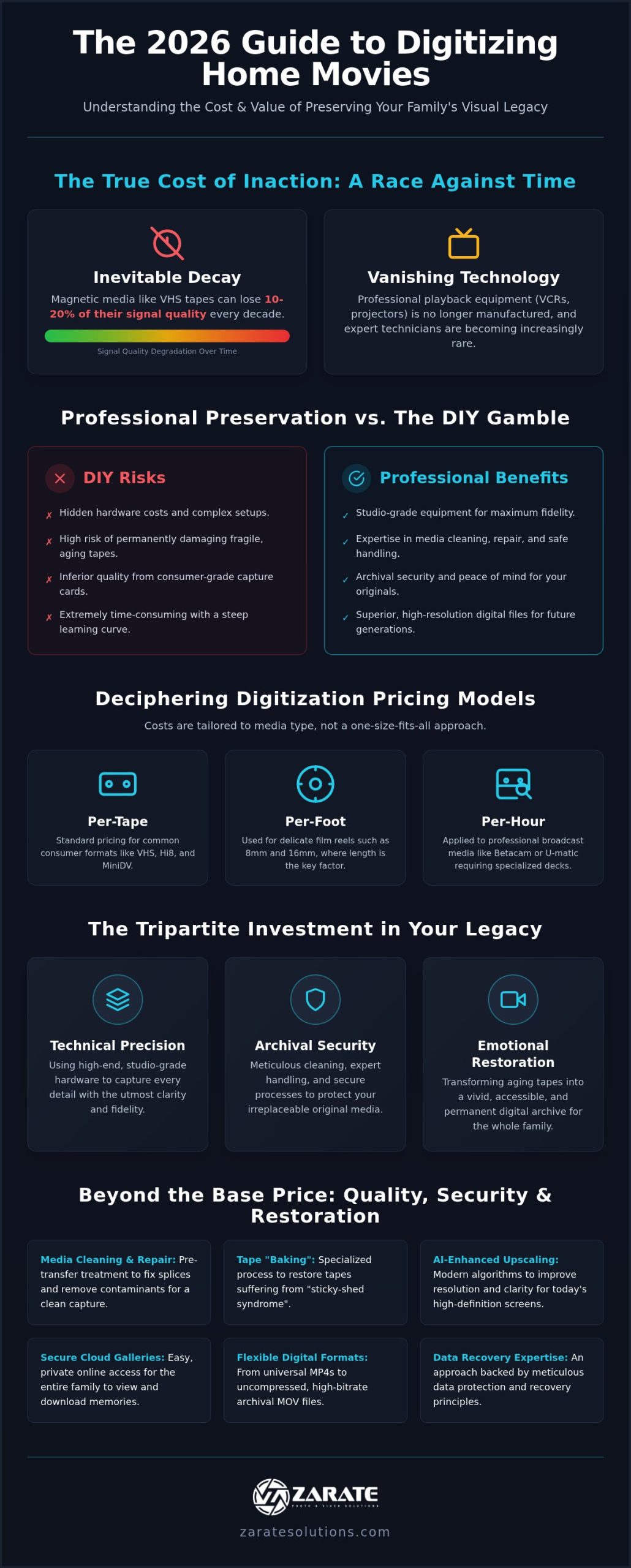
Time is the greatest enemy of the analog reel. Industry estimates suggest that magnetic media can degrade by as much as 10% to 20% every decade, leading to signal loss, color shifts, and audio distortion. In 2026, we’ve reached a critical threshold for tapes produced in the 1990s. Beyond natural decay, the world is facing an acute scarcity of working playback equipment. Professional-grade VCRs and film projectors are no longer manufactured, and the specialized technicians required to maintain this vintage machinery are becoming harder to find. Waiting another decade doesn’t just risk the quality of the image; it risks the ability to play the media at all.
The Value of Professional Stewardship
There’s a profound difference between a basic file transfer and true media preservation. A mass-market service might offer a low cost to digitize home movies, but they often lack the individual attention that a bespoke archivist provides. At Zarate Photo & Video Solutions, we approach every project with the eye of an artist and the precision of a data recovery expert. We don’t just move data from one place to another. We safeguard your legacy through meticulous cleaning, careful handling, and a commitment to technical excellence. This tailored approach ensures that the final digital files aren’t just functional, but are beautiful, high-fidelity representations of your most cherished moments. Families who have trusted us to preserve milestone celebrations — from birthday gatherings to quinceañeras documented through comprehensive quinceañera photo and video packages — understand that this same dedication to quality extends to every format we handle.
Deciphering Pricing Models for Analog Media Formats
Understanding the financial architecture of digitization requires a shift away from flat-rate thinking. While mass-market retailers often simplify their offerings into a single price per box, this approach frequently ignores the technical variance between a standard VHS and a delicate 16mm reel. When you evaluate the cost to digitize home movies, you’re essentially investing in a bespoke workflow that varies by format, condition, and desired output. The pricing you encounter is generally structured around three primary models: per-item for tapes, per-foot for film, or per-hour for professional media. Each model reflects the specific labor, equipment maintenance, and archival security required to handle that particular medium.
Efficiency is often found in volume. Digitizing a collection of twenty tapes is typically more cost-effective than processing a single item, as the administrative overhead and equipment calibration are distributed across the entire project. Beyond the capture itself, you must also consider the digital destination of your memories. While compressed MP4 files offer universal compatibility for casual viewing, serious archivists often request uncompressed MOV files or high-bitrate archival formats for long-term storage and future editing. If you’re uncertain about which format serves your legacy best, our team can help you select the ideal digital output for your unique collection.
Magnetic Media: VHS, Hi8, and MiniDV
Consumer magnetic tapes represent the most common artifacts in family archives. Standard formats like VHS, Hi8, and MiniDV are typically billed on a per-tape basis. However, the price often reflects more than just a simple transfer. Professional-grade tapes, such as Betacam or U-matic, require specialized playback decks that are increasingly rare and expensive to maintain. If your tapes show signs of physical distress, the preservation process must include a restorative phase. This involves cleaning, repairing, or even “baking” tapes that suffer from sticky-shed syndrome. This meticulous intervention ensures the tape doesn’t snap during the capture process, protecting both your footage and the archival equipment. For a comprehensive overview of the technical steps involved, our guide on how to convert VHS tapes to digital walks through the full professional digitization workflow in detail.
Celluloid Film: 8mm, Super 8, and 16mm
Film preservation follows a different logic entirely. Because reels vary in diameter and frame rate, pricing is almost always calculated per linear foot. A small 3-inch reel typically contains about 50 feet of film, while larger reels can reach 400 feet or more. The resolution you choose significantly influences the final investment. While standard definition may suffice for some, many families now opt for 4K frame-by-frame scanning to capture every nuance, color, and texture of the original celluloid. For a deeper dive into these technical standards, consult our 8mm Film to Digital: Guide to Archival Preservation. This specialized process treats each frame as an individual photograph, resulting in a level of clarity that consumer-grade scanners simply cannot replicate.
Professional Studio Services versus the DIY Investment
The decision to preserve your family archive often begins with a choice between the perceived autonomy of a DIY project and the meticulous precision of a professional studio. Many believe that handling the process personally is a cost-effective alternative. However, when you calculate the total cost to digitize home movies using home equipment, the financial and emotional reality is often far more complex. DIY isn’t just a time commitment. It’s a technical undertaking that requires specialized, aging hardware that is increasingly difficult to source, calibrate, and maintain. This path often leads to a false economy where the investment in equipment and labor exceeds the price of expert service.
The “Quality Gap” is the most striking difference between these two paths. A standard consumer USB converter, while affordable, lacks the sophisticated circuitry needed to stabilize the jittery signals of thirty-year-old magnetic tape. In contrast, studio-grade capture cards work in tandem with hardware-based signal processors to ensure every frame is captured with absolute fidelity. Beyond the visual results, there’s the matter of physical safety. A poorly maintained VCR from a thrift store or attic can easily scratch or “eat” a tape, turning an irreplaceable memory into a tangled mess of plastic within seconds. Professional stewardship eliminates these variables, offering a secure environment where your history is treated with the gravity it deserves.
The DIY Equipment Checklist
To achieve even a baseline level of archival quality, your home setup requires more than just a computer and a cable. You’ll need a high-quality S-VHS playback deck, an external Time Base Corrector (TBC) to stabilize the analog signal, and a reliable capture device that won’t drop frames. Sourcing these components in 2026 often means navigating a volatile market of used electronics with no guarantees of performance. Once the hardware is assembled, you face a steep learning curve involving color grading, audio restoration, and file optimization. For a more detailed breakdown of these requirements, we recommend reviewing our Professional Photo Scanning vs. DIY Checklist, which outlines the high standards expected in a modern preservation workflow.
The Professional Advantage
Choosing a professional studio grants you access to an ecosystem of technology that is simply unavailable to the average consumer. We utilize broadcast-quality playback decks, industrial-grade cleaners, and professional signal monitors to ensure the highest possible capture quality. Our archivists possess the deep expertise required to correct tracking errors, mitigate magnetic signal loss, and restore faded colors. This process is about more than just technical skill. It’s about the security of a professional facility where your originals are tracked, guarded, and respected. You aren’t just paying for a file transfer. You’re investing in the peace of mind that comes from knowing your legacy is in the hands of a dedicated guide who values your history as much as you do.
Beyond the Base Price: Quality, Security, and Restoration
The total cost to digitize home movies often extends beyond the initial capture fee, as discerning families seek to bridge the gap between a raw transfer and a polished cinematic experience. In 2026, the integration of AI-enhanced upscaling and sophisticated noise reduction has redefined the standard for archival quality. These advanced tools allow us to sharpen soft edges, stabilize handheld camera shake, and mitigate the grainy texture common in low-light home recordings. While mass-market services might provide a static copy, a bespoke approach ensures your memories are refined, polished, and elevated for modern 4K displays.
Your digital archive requires a home as secure as the original vault. We offer a choice between high-capacity USB drives for physical possession and private cloud galleries that allow for effortless sharing across the globe. Transitioning your media also involves a physical journey. We prioritize your peace of mind by utilizing GPS-tracked logistics and comprehensive insurance, ensuring that your irreplaceable reels are monitored from the moment they leave your hands until they are safely returned. Customization options, such as bespoke titling and logical chaptering, further transform a chaotic box of tapes into a curated, navigable, and engaging family library. Families who have also invested in professionally documented milestone events — such as those who selected elite quinceañera photo and video packages to capture a daughter’s coming-of-age celebration — frequently return to us to digitize older home recordings so that every chapter of their family story is preserved with equal care.
Technical Restoration Factors
Faded 1970s film often suffers from a distinct magenta shift, a chemical breakdown that robs the footage of its natural vibrancy. Professional color correction breathes life back into these scenes, restoring the deep blues of a summer lake or the warm glow of a holiday gathering. Simultaneously, audio enhancement processes work to isolate human voices while stripping away the persistent hiss and hum inherent in aging magnetic tape. Bitrate refers to the amount of data processed per unit of time, where a higher bitrate ensures that 4K video retains the complex textures and subtle color gradients of the original film without introducing digital artifacts. If you have specific restoration goals, you can request a custom consultation to discuss your collection’s unique needs.
Security and Data Integrity
Preservation is a commitment to permanence. We adhere to a strict standard of redundancy, ensuring that every file exists in at least two separate digital locations to guard against hardware failure. If your media arrives with existing physical damage or corruption, our specialized Digital Media Recovery Service provides a path to salvage what might otherwise be lost. Privacy is paramount. Every project is handled within our secure, professional, and strictly controlled facility, ensuring your personal history remains confidential while receiving the highest level of technical care.
Entrusting Your Legacy to Zarate Photo & Video Solutions
Preserving a family legacy is an act of profound respect. At Zarate Photo & Video Solutions, we reject the impersonal, high-volume approach of warehouse retailers in favor of a tailored preservation model. We understand that your collection isn’t just a box of plastic and tape; it’s a vibrant narrative of life’s most significant milestones. While the literal cost to digitize home movies is a practical consideration, the true value lies in the hands of the archivist who handles your history. Our background in professional data recovery ensures your media is handled with extreme care, while our expertise in high-end event photography allows us to recognize, enhance, and celebrate the emotional weight of your footage.
Our Bespoke Process
Every project begins with a personal consultation to understand the scope, condition, and goals of your archive. We treat every fragile film reel and weathered photo album as a unique artifact requiring a specific, meticulous workflow. This dedication to detail is what defines our service as a premium solution for those who value quality over convenience. We take the time to clean, inspect, and prepare your media before a single frame is captured. For those with extensive physical archives, our Connoisseur’s Guide to Photo Album Scanning offers deeper insight into how we safeguard your visual history with the same level of care we apply to motion media.
The Zarate Guarantee
We’re committed to more than just a technical transfer. Our goal is to preserve the emotional resonance, the subtle gestures, and the unique atmosphere of your past. This commitment combines professional reliability with a refined, client-centric experience that adapts to your individual needs. We don’t just provide files; we provide a sophisticated, secure, and permanent bridge to your history. You can trust that your originals will be returned with the same reverence with which they were received. To begin your journey toward a permanent digital archive, consult with our preservation experts today to request a bespoke quote for your unique collection.
Securing Your Visual Heritage for the Future
Preserving your family’s most intimate moments is a profound commitment to the future. Determining the true cost to digitize home movies involves weighing the technical risks of magnetic decay against the enduring value of a professionally restored archive. By choosing a partner who understands both the science of data recovery and the art of storytelling, you ensure that your history is not just transferred, but truly protected. Our national media preservation service combines an expert data recovery background with specialized high-resolution scanning technology to deliver results that mass-market alternatives simply cannot match.
The race against physical degradation and equipment obsolescence is ongoing, but it’s a race you can win. Taking action today transforms a box of fragile tapes into a vibrant, accessible digital legacy that will resonate for generations. We invite you to preserve your family legacy with a bespoke quote from Zarate Solutions. Your history is unique, and it deserves a preservation strategy that is equally exceptional. Let’s begin the process of safeguarding your most precious memories together.
Frequently Asked Questions
How much does it typically cost to digitize one VHS tape in 2026?
The investment required for a single VHS tape depends on its duration, physical condition, and the level of restoration requested. In 2026, industry rates reflect the scarcity of working playback machinery and the specialized labor needed for signal stabilization. While mass-market options exist, a bespoke service ensures that your tape is cleaned, tracked, and captured using broadcast-quality decks that preserve every nuance of the original recording.
Is there a discount for digitizing home movies in bulk?
Volume-based pricing is a standard practice that rewards the preservation of entire collections. When you calculate the cost to digitize home movies in bulk, the administrative overhead and equipment calibration time are distributed across multiple items. This approach is both more efficient for the archivist and more cost-effective for the client, allowing for a comprehensive preservation of your family’s visual narrative in one unified project.
What is the most expensive format to digitize and why?
Professional 16mm film and broadcast-grade magnetic formats like Betacam or U-matic typically represent the highest tier of preservation investment. These formats require industrial-grade machinery that is exceptionally rare and expensive to maintain in 2026. The process often involves frame-by-frame scanning and specialized signal processing, demanding a level of technical precision and manual oversight that standard consumer formats do not require.
Are there hidden fees for high-resolution 4K file formats?
Higher resolution outputs like 4K often involve additional fees due to the significant increase in data processing and archival storage requirements. Capturing at 4K requires professional-grade sensors and high-bitrate encoding to ensure the digital file retains the texture of the original film. These files are much larger than standard definition transfers, necessitating more robust storage solutions and longer rendering times to maintain absolute visual fidelity.
Does the cost include cleaning and repairing old or moldy tapes?
Meticulous cleaning and physical repair are specialized services that go beyond the scope of a standard digital transfer. If your tapes suffer from mold, sticky-shed syndrome, or broken housings, they must undergo a restorative phase before they can safely touch a playback head. This labor-intensive process is essential to prevent permanent damage to your irreplaceable footage and to safeguard the archival equipment used during the capture.
Can I get a quote for a mixed collection of photos, slides, and videos?
Bespoke quotes are the most effective way to address the complexities of a mixed family archive containing photos, slides, and various video formats. Every medium requires a unique technical approach, from high-resolution reflective scanning for prints to frame-by-frame capture for film. A tailored estimate provides a transparent breakdown of the resources required to unify, protect, and share these disparate memories in one cohesive digital library.
How does the cost of cloud storage compare to buying a physical USB drive?
Cloud storage provides a modern solution for accessibility and redundancy, while a physical USB drive offers a tangible backup you can hold. Secure cloud galleries allow you to share memories instantly with relatives across the globe, often involving a recurring subscription fee for data maintenance. In contrast, a USB drive is a one-time hardware purchase, though it lacks the automatic backups and multi-device access inherent in cloud-based archival systems.
Why is professional digitization more expensive than buying a DIY converter?
Professional services utilize broadcast-grade signal processors and hardware-based Time Base Correctors that consumer DIY converters lack. These tools stabilize jittery signals, correct color shifts, and prevent frame drops that common USB dongles frequently produce. When you evaluate the cost to digitize home movies, you’re investing in the expertise of an archivist who understands how to navigate the technical hurdles of aging media without risking permanent tape breakage. To better understand the full scope of what professional preservation entails, our detailed resource on converting VHS tapes to digital with archival precision provides an in-depth look at the hardware requirements and workflow standards that separate professional results from consumer-grade transfers.