

You sit down to relive the most beautiful day of your life, only to be met with a blank screen and a cold, clinical error message. The heart-stopping realization that your wedding photos might be gone isn’t just a technical glitch; it’s a profound sense of loss that feels deeply personal and entirely overwhelming. It’s natural to feel a crushing weight of distress when milestones vanish into the digital void, especially when the jargon of corrupted file systems feels like an impossible barrier. If you’ve found yourself in this position, please know that expert wedding photo recovery is not only possible but is a meticulous process designed to restore what is breathtaking, fleeting, and irreplaceable.
We understand that your wedding imagery represents more than just data; it’s the foundation of your family’s history and a testament to your personal narrative. This guide will help you discover the technical pathways and professional solutions required to retrieve lost files and protect your digital legacy. We’ll explore how archival expertise can reverse data loss, provide the reassurance you need to move forward, and establish a robust prevention plan for all your future events. You’ll learn how to navigate this challenge with quiet confidence, ensuring your most precious memories are handled with the high-end craftsmanship they deserve.
Key Takeaways
- Identify the primary causes of media failure, including accidental deletion, file system corruption, and the inherent vulnerabilities of flash memory.
- Evaluate the significant risks associated with DIY software and discover why professional wedding photo recovery is the most secure path to restoring your digital legacy.
- Gain insight into the technical anatomy of restoration, from initial diagnostic assessments to the complex reconstruction of damaged file headers.
- Implement a sophisticated preservation plan using the 3-2-1 backup rule, ensuring your most cherished milestones remain protected, accessible, and secure.
- Discover a bespoke approach to archival restoration that combines technical forensic precision with a deep respect for the emotional weight of your personal narrative.
Understanding the Crisis: Why Wedding Photo Loss Occurs
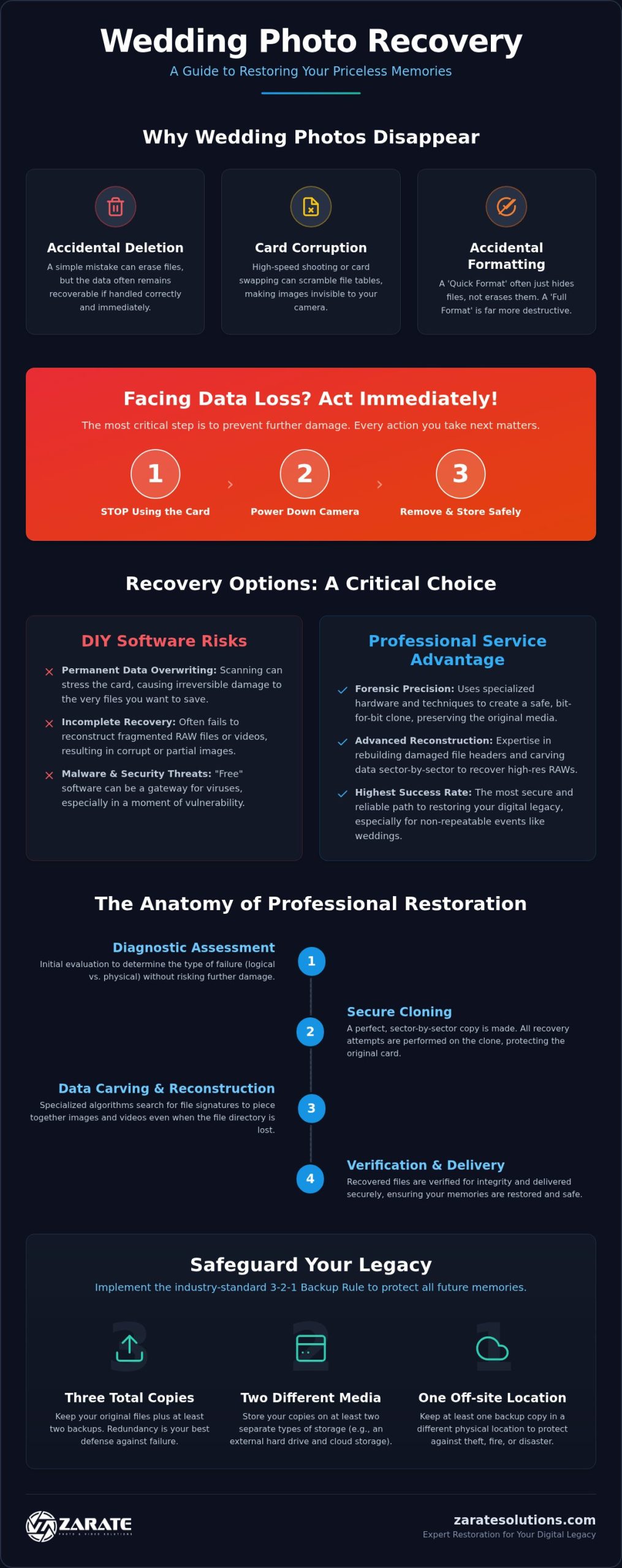
The silence of a failed memory card is deafening. It’s a moment of pure, unadulterated panic. Most digital losses stem from three common culprits: accidental deletion, unintended formatting, or silent file system corruption. While the camera screen may display a chilling “No Images Found” message, the reality is often more hopeful. The data remains. It’s hidden, dormant, and waiting. Professional wedding photo recovery is built on the fact that your images aren’t truly gone until they are physically overwritten by new information.
The most vital action you can take right now is to stop. Remove the card. Set it aside. Power down the camera immediately. Every new click of the shutter or attempt to “fix” the card with consumer software risks overwriting the very bitstream we need to save. In the delicate world of digital preservation, a quiet cessation of activity is your greatest ally. Professional restoration begins with a secure environment where the integrity of the original media is preserved, protected, and prioritized.
The Science of SD Card and CFexpress Corruption
Flash memory isn’t permanent. It’s a complex dance of electrons and logic gates. During the high-speed write operations of a wedding day, file allocation tables (FAT32 or exFAT) can become scrambled, misaligned, or broken. This is often exacerbated by the extreme heat of high-resolution recording or the frantic swapping of cards between ceremonies. We must distinguish between logical errors, where the map of the data is lost, and physical hardware failure, where the silicon itself is damaged. Understanding this data recovery process requires a blend of forensic precision and archival care to ensure every frame is accounted for and every memory is secured.
Accidental Deletion vs. Partial Formatting
Not all deletions are equal. A “Quick Format” simply wipes the directory index, leaving the actual image data intact as ghost files on the card. Conversely, a “Full Format” or “Low-Level Format” can be catastrophic; it actively zeroes out the sectors and makes retrieval nearly impossible. For high-resolution RAW imagery, we look for file signatures that survive even when the directory structure is gone. Data carving is the process of identifying file signatures without directory metadata. This allows us to reconstruct your narrative through meticulous, sector-by-sector analysis that honors the artistic intent of every shot. It’s a process that’s precise, exhaustive, and restorative.
Evaluating Recovery Options: DIY Software vs. Professional Services
The internet is saturated with promises of instant, free solutions. When faced with the loss of a wedding gallery, the impulse to download a quick fix is nearly irresistible. However, the stakes of wedding photo recovery are far higher than a standard office document. For a once-in-a-lifetime event, the margin for error is non-existent. While the initial price of professional intervention may seem higher than a software license, the true cost is measured in the value of the memories saved. A wedding is a non-repeatable event. There are no do-overs. Investing in professional wedding photo recovery is an investment in the permanence, security, and legacy of your personal history.
The risks of amateur attempts are often hidden until it’s too late. Every time an unoptimized tool scans a failing card, it stresses the physical sectors, potentially leading to permanent bit rot. This irreversible degradation means that even if a file is eventually found, it may be hopelessly corrupted. Engaging a professional digital media recovery service ensures that your media is treated with the gravity, respect, and technical precision it deserves.
The Risks of Consumer-Grade Recovery Tools
Most consumer tools are designed for simple file deletions on healthy drives. They often fail to reconstruct fragmented data, leaving you with partial images or unplayable video files. Worse yet, the free software landscape is rife with predatory applications that install malware during your moment of vulnerability. If you notice the card becoming hot, the scan progress stalling, or the software requesting a repair of the file system, stop immediately. These are signs that the damage is deepening. When automated tools fall short, a dedicated sd card photo recovery service provides the sophisticated, secure expertise needed to address both logical and physical failure without risking further damage to your irreplaceable memories.
The Professional Advantage: Clean Rooms and Bit-Level Imaging
Professional intervention begins with a fundamental rule: never work on the original media. Experts create a bit-level clone of the card, ensuring the source remains untouched. This requires specialized hardware imagers that can identify, isolate, and recover data from bad sectors that standard operating systems ignore. For those dealing with more complex storage issues, understanding how to recover photos from a damaged hard drive safely is critical to preventing total hardware failure.
Preserving your past requires a partner who understands both the technical and emotional nuances of your media. At Zarate Photo & Video Solutions, we approach every recovery as a meticulous archival task. If you’re currently facing a data crisis, seeking a professional evaluation is the first step toward reclaiming your most precious memories.
The Technical Anatomy of a Professional Recovery Process
Professional restoration is a disciplined, multi-phased methodology that transcends simple software scans. It is a forensic art. While consumer tools often stop at the surface, a professional wedding photo recovery involves a deep dive into the raw bitstream of your media. This process is designed to be exhaustive, secure, and restorative, ensuring that every captured moment is returned to its original state. By following a structured sequence of events, we transform a technical crisis into a successful archival preservation.
The journey begins with a comprehensive diagnostic and integrity assessment. We analyze the physical health of the card, identify logical inconsistencies, and determine the most viable path for retrieval. Once the media is stabilized, we move into deep-sector scanning. This phase involves the meticulous reconstruction of file headers, which serve as the digital fingerprints of your images. Without these headers, a file is merely an unreadable collection of data; by rebuilding them, we give the data back its identity, structure, and purpose.
Before any files are returned to you, they undergo manual verification. We examine the recovered assets for visual artifacts, banding, or corruption that automated tools frequently overlook. This ensures that the final delivery meets the high standards of a professional gallery. Finally, your restored memories are prepared for secure delivery via encrypted archives, providing a final layer of protection as your personal history is returned to your care.
Handling Proprietary RAW Formats
Wedding photographers rely on proprietary formats like CR3, ARW, and NEF to capture the highest level of detail. These files are significantly more complex than standard JPEGs, requiring specialized algorithms to interpret their unique data structures. Our process prioritizes the preservation of metadata and EXIF data, which are essential for maintaining the chronological timeline of your wedding day. Professional recovery preserves the “digital negative” quality required for high-end printing. This ensures that your photos remain flexible, detailed, and vibrant for future editing or large-scale displays.
Recovering Corrupted Wedding Videography
Video restoration is exponentially harder due to the nature of file fragmentation. Unlike photos, high-bitrate video files are often scattered across different sectors of a card, making them prone to “stuttering” or total failure if not reconstructed correctly. We employ advanced techniques to stitch together related data blocks, effectively rebuilding the cinematic narrative frame by frame. This meticulous approach ensures that audio-visual sync remains intact, preserving the laughter, vows, and music of your celebration without technical distraction.
Safeguarding Your Legacy: Post-Recovery Best Practices
The successful retrieval of your files is a moment of profound relief. It is also a call to action. Once the immediate crisis of wedding photo recovery has passed, the focus must shift from rescue to resilience. A digital legacy is not a static object; it is a living archive that requires intentional, organized, and resilient management. By implementing professional-grade protocols today, you ensure that your history remains protected, accessible, and secure for the generations that follow.
The 3-2-1 backup rule is the foundation of modern archival security. This strategy dictates that you maintain three total copies of your data, stored on two different types of media, with at least one copy kept offsite. In the context of your wedding, this might look like a local hard drive, a dedicated Solid State Drive (SSD), and an encrypted cloud service. This multi-layered approach protects your memories from hardware failure, accidental loss, and environmental hazards. Cloud-to-local redundancy is no longer a luxury. It is a necessity in a world where technology evolves faster than our ability to track it.
Hardware hygiene is equally critical. If an SD card has suffered a significant corruption event, its professional life is over. Retire it immediately. While wedding photo recovery can often save the data, the underlying physical instability of the card remains a risk. When hiring future photographers, prioritize those who utilize dual-slot recording. This feature writes data to two cards simultaneously, providing a real-time fail-safe against media failure during the event itself.
Building a Bespoke Digital Archive
Selecting the right storage media is a balance of speed and longevity. SSDs are ideal for active viewing and editing due to their rapid read speeds, while traditional Hard Disk Drives (HDDs) often provide more cost-effective options for long-term “cold” storage. Periodic data scrubbing is essential to identify and repair silent corruption, a phenomenon where bits of data degrade over time without warning. Elite professionals integrate these safeguards from the moment the first photo is taken. To understand how these technical standards are woven into high-end service, explore our customizable wedding photography packages.
The Role of Analog-to-Digital Conversion
A physical print is the ultimate offline backup. It requires no electricity, no software updates, and no subscription to remain visible. Converting your high-resolution digital files into archival-grade prints or heirloom albums creates a tangible history that survives the obsolescence of digital formats. Zarate’s conversion services help bridge the gap between digital data and tangible history, ensuring your milestones exist in both worlds. Secure your digital legacy today by scheduling a professional archival consultation with our team.
Professional Restoration: The Zarate Photo & Video Solutions Standard
Restoring a lost gallery is a sacred responsibility. At Zarate Photo & Video Solutions, we understand that every image we retrieve is a cornerstone of your family’s history. Our approach to wedding photo recovery transcends simple data retrieval; it’s a sophisticated blend of technical forensic precision and an artist’s eye for detail. We don’t just see sectors and bits. We see the soft light of a ceremony, the candid laughter of a reception, and the quiet intimacy of a first look. This commitment to the emotional weight of your personal narrative ensures that your memories are handled with the gravity, respect, and craftsmanship they deserve.
Our process is designed to be transparent, secure, and reassuring. We recognize that you’re coming to us in a moment of high-stakes distress. Because of this, we prioritize clear communication and meticulous care from the moment your media arrives. You aren’t just another ticket in a queue. You’re a partner in a preservation project. By choosing an expert who understands both the technical architecture of a file and the aesthetic value of a photograph, you ensure that your restored imagery remains vibrant, authentic, and complete.
A Tailored Approach to Every Recovery
We treat every wedding gallery as a unique historical archive. Our team utilizes advanced, US-based technical facilities to perform deep-sector analysis, ensuring that even the most stubborn logical errors are addressed with precision. For specific logical recovery cases, we offer a “no data, no fee” policy to provide an additional layer of security and trust. This professional partnership offers a level of peace of mind that mass-market software simply cannot replicate. Your data is protected, preserved, and restored by specialists who value quality over quantity.
Next Steps: Restoring Your Peace of Mind
Initiating your wedding photo recovery service begins with a bespoke consultation. To ensure the highest success rate, we provide specific instructions on how to safely package and ship your media to our laboratory. Once received, you can expect a detailed diagnostic report within a 24-hour window. This initial assessment establishes the integrity of the media and defines the clear pathway to restoration. Don’t leave your digital legacy to chance or unproven tools. Trust your most precious memories to the meticulous archivists at Zarate Photo & Video Solutions, and let us help you reclaim the story of your most beautiful day.
Reclaiming Your Narrative: The Path to Restoration
Your history is worth saving. While the initial shock of data loss is overwhelming, the technical pathways to restoration are clear, proven, and accessible. We’ve explored how immediate cessation of device use, the avoidance of consumer-grade software, and the implementation of robust backup protocols can transform a crisis into a successful archival project. By choosing professional expertise over risky DIY attempts, you ensure that your high-resolution RAW files and cinematic videos are handled with the forensic precision they require. Every milestone deserves a second chance, and every story deserves to be told in full.
The journey of wedding photo recovery is a delicate process, but it’s one that leads toward a secure and resilient digital legacy. Our team of expert media archivists operates from a secure US-based laboratory, specializing in the complex professional photography formats that define modern milestones. We invite you to Contact Zarate Photo & Video Solutions for a Professional Recovery Consultation to begin the meticulous work of reclaiming what was lost. Your memories are resilient, and with the right partner, they can be restored, preserved, and cherished once again.
Frequently Asked Questions
Can I recover deleted wedding photos from an SD card that has been used again?
Recovery is possible but becomes significantly more difficult once new data is written to the card. If you’ve only taken a few additional shots, large portions of the original bitstream may still remain untouched in the unallocated space. However, every new file created increases the risk of overwriting your irreplaceable memories. For a successful wedding photo recovery, it’s vital to stop using the media the instant you suspect a loss.
How much does professional wedding photo recovery typically cost?
The investment for professional restoration depends on the severity of the logical or physical failure. Factors such as the storage capacity of the media, the complexity of the file system, and the urgency of the restoration all influence the final requirement. While mass-market software carries a flat fee, bespoke professional services provide a tailored solution that prioritizes the integrity, completeness, and security of your most significant milestones.
Is it possible to recover photos from a physically snapped or water-damaged card?
Yes, restoration is often achievable even for media that has suffered physical trauma or environmental exposure. Physical damage requires a meticulous, hardware-level approach where the memory chips are stabilized or moved to a donor board in a controlled environment. Water-damaged cards must be professionally cleaned and dried to prevent short-circuiting the delicate internal components. These high-stakes scenarios require the precision, patience, and specialized tools found in a professional laboratory.
How long does the professional recovery process usually take?
You can typically expect an initial diagnostic assessment within 24 hours of your media arriving at our facility. The full restoration timeline varies based on the complexity of the corruption, the total volume of data, and the physical health of the card. Most professional wedding photo recovery projects are completed within several business days. We prioritize both technical thoroughness and timely delivery to return your memories as swiftly and securely as possible.
Will the recovered photos lose quality or resolution compared to the originals?
Correctly restored files maintain 100% of their original quality, resolution, and bit-depth. Professional recovery isn’t a “copy” or a “re-creation”; it’s the retrieval of the exact binary data that was written at the moment of capture. Whether you’re dealing with high-resolution JPEGs or complex RAW files, the final output will be bit-for-bit identical to the original. This ensures your images remain suitable for large-scale printing, detailed editing, and long-term archival.
Can you recover wedding videos that have become unplayable or “choppy”?
Yes, we can frequently restore unplayable or truncated video files by rebuilding the underlying data structure. Wedding videography is often recorded at high bitrates, leading to significant fragmentation across the memory card’s sectors. Our process involves identifying these scattered fragments and stitching them back together into a cohesive, synchronized narrative. We focus on repairing the file headers and containers to ensure your cinematic highlights play smoothly without technical artifacts.
What should I do the moment I realize my wedding photos are missing?
The moment you realize your wedding imagery is missing, you must immediately cease all device use and remove the memory card from the camera. This prevents the system from overwriting the dormant data with new files or temporary metadata. Secure the media in a protective case, keep it away from extreme temperatures, and avoid the temptation to run unverified consumer recovery tools. These initial steps are critical for protecting the bitstream and ensuring a successful restoration.
Is my data kept private and secure during the recovery process?
Your privacy is a foundational priority, protected by strict confidentiality protocols and secure data handling practices. We utilize encrypted transfer methods and isolated local storage to ensure your personal narrative remains entirely private throughout the restoration journey. Access to your imagery is restricted to the technical team performing the recovery. Once your restored gallery is safely in your hands, we follow a secure deletion process for any temporary working copies.