
Imagine the heavy silence that follows when a camera screen flashes a “Card Error” after a day spent capturing a child’s first steps, a couple’s first kiss, or a grandmother’s milestone birthday. These digital fragments aren’t merely files; they’re the vibrant, irreplaceable, and deeply personal milestones of your family history. It’s natural to feel a sharp sting of anxiety when faced with technical jargon like “file system corruption,” particularly when you worry that a DIY attempt might worsen the damage. You deserve a solution that’s as meticulous as the memories you’re trying to save.
While many turn to basic software in a moment of desperation, a professional sd card photo recovery service provides the sophisticated, secure, and comprehensive expertise needed when automated tools fall short. This article will guide you through the transition from digital loss to total restoration. We’ll explore the critical nuances between logical and physical failure, the technical safeguards that ensure your privacy, and the peace of mind that comes from placing your media in the hands of a dedicated archivist. Discover how expert intervention can protect, restore, and honor the stories you never intended to lose.
Key Takeaways
- Distinguish between logical and physical failures to understand why professional intervention succeeds where standard software often fails.
- Avoid the risk of media exhaustion by choosing a non-destructive recovery process that prioritizes data integrity over repetitive, potentially damaging DIY attempts.
- Utilize a specialized sd card photo recovery service to navigate complex file system corruption and restore your irreplaceable family or corporate milestones.
- Adopt the “Rule of Three” for backups to ensure your digital legacy remains protected against the inherent limitations of temporary flash storage.
- Experience a bespoke approach to media preservation that treats every recovered image and video with the reverence and technical precision it deserves.
What is an SD Card Photo Recovery Service?
A professional sd card photo recovery service represents the precise intersection of forensic technology and digital preservation. It’s a specialized technical process designed to retrieve inaccessible, deleted, or corrupted files from flash memory devices when standard access methods fail. While consumer software often focuses on simple deletions, a professional service addresses a broader spectrum of failure, including physical, logical, and electrical malfunctions. This level of care is essential for high-value media, such as wedding photography, corporate event archives, and irreplaceable family histories, where the cost of permanent loss is immeasurable.
This specialized approach moves beyond the surface-level scans of basic applications. It involves a meticulous evaluation of the card’s health, the stability of its internal controller, and the integrity of the NAND flash chips themselves. The broader data recovery process requires a deep understanding of how digital information is organized and stored. By utilizing advanced hardware tools and proprietary algorithms, experts can bypass damaged components or reconstruct fragmented data that would otherwise remain invisible to a standard computer. This ensures that your digital narrative is handled with the same reverence a museum conservator might apply to a centuries-old manuscript.
Common Scenarios Requiring Professional Intervention
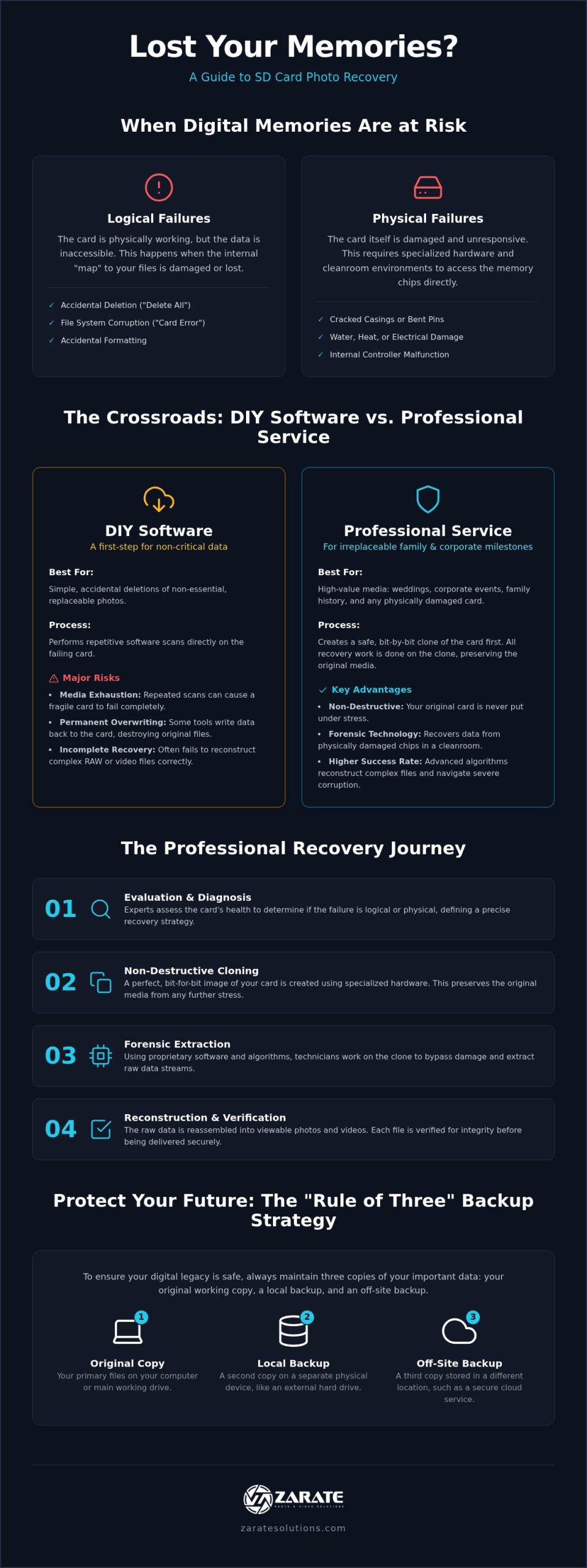
Loss often occurs in the blink of an eye. You might accidentally trigger a “Delete All” command during a high-pressure shoot, or find that a camera suddenly reports a “Card Error” due to file system corruption. These logical failures happen when the internal map of your data becomes unreadable, leaving your images trapped in a digital limbo. In more severe cases, physical damage, such as cracked casings, bent pins, or exposure to moisture, renders the card completely unresponsive. Each of these scenarios requires a tailored, expert response to prevent total data destruction. Professional intervention provides a safety net that is both decisive in its execution and comprehensive in its scope.
The Limitations of Consumer-Grade Recovery Software
Relying on consumer-grade software can be a precarious gamble for significant memories. Many “free” tools lack the sophisticated logic required to reconstruct complex RAW image files or fragmented video streams, often resulting in partial or corrupted files. Even more concerning is the danger of “write-back” errors. This happens when a tool attempts to repair the card by writing new data over the very sectors you’re trying to save, which can permanently destroy the original data. When a card suffers from severe electrical failure or physical degradation, it requires a cleanroom environment and specialized equipment to safely extract data directly from the memory chips. These are precision tasks that no downloadable program can achieve.
Professional Recovery vs. DIY Software: Making the Right Choice
Deciding how to proceed after a digital failure is a pivotal moment for your media. The choice between a downloadable utility and a dedicated sd card photo recovery service often depends on the emotional and professional weight of the images involved. You must evaluate the stakes with honesty. Is this a collection of replaceable snapshots from a casual weekend trip, or are you facing a high-stakes wedding photo recovery situation where every frame represents a singular, unrepeatable legacy? When the media is irreplaceable, the cost of a professional service is a small investment in the security, restoration, and preservation of your history.
Many users underestimate the technical fragility of a failing SD card. DIY software tools typically perform intensive, repetitive scans that can lead to “media exhaustion.” This occurs when a dying NAND flash chip finally expires under the physical stress of repeated read attempts. Professional labs avoid this risk by using specialized hardware imagers. These devices create an exact, bit-by-bit clone of the media before any repair or extraction is attempted. This non-destructive methodology ensures that the original data remains untouched, providing a safe digital foundation for the recovery process. If you find yourself at this crossroads, a professional consultation can provide the clarity needed to protect your digital legacy.
When Software is a Safe First Step
There are instances where a software solution is a reasonable starting point. If you’ve accidentally deleted a few files from a healthy, high-quality card that is still fully recognized by your operating system, software may suffice. This is particularly true for basic JPEG files where fragmentation is unlikely. In these specific, low-risk scenarios, a careful scan can often reveal the hidden files without further compromising the storage media.
- Accidental deletions on a card that shows no signs of physical or logical error.
- Media that is correctly identified by your computer’s file explorer with its full capacity shown.
- Simple file recovery where the card has not been used or written to since the loss occurred.
When Professional Service is Non-Negotiable
Certain symptoms signal a critical failure that software cannot fix. If your computer displays “No Media” or “Insert Disk” despite the card being firmly seated, the internal controller has likely failed. Physical warning signs, such as a card that feels abnormally hot to the touch or shows signs of smoke, require immediate power-down to prevent permanent melting of the internal circuits. Furthermore, complex video recovery often requires manual reconstruction of file headers, a task that demands the expertise of a seasoned archivist rather than an automated script.
- The device is completely unresponsive or unrecognized by multiple card readers.
- The card exhibits physical damage, such as cracks, bent connectors, or heat discoloration.
- The lost data includes high-resolution RAW images or corrupted video files that require deep forensic reconstruction.
How the SD Card Recovery Process Works
The transition from the panic of data loss to the relief of a restored archive is a journey defined by technical precision and emotional respect. Entrusting your media to a professional sd card photo recovery service replaces the chaos of failure with a methodical, secure, and transparent protocol. Unlike the unpredictable nature of home software attempts, this archival journey follows a rigorous lifecycle designed to protect the integrity of every individual pixel. From the moment your card enters the lab, our focus remains on the meticulous restoration of your personal or corporate narrative, ensuring that no chapter of your history is left behind.
Step 1: The Initial Diagnostic and Evaluation
Precision begins with a comprehensive health assessment. Technicians analyze the physical stability of the card’s controller and the current state of the NAND flash chips to determine the underlying cause of the malfunction. This stage is vital for identifying specific file signatures, particularly for specialized formats like high-bitrate 4K video or high-resolution RAW data. We provide a clear roadmap and a realistic success probability, allowing you to move forward with confidence and clarity. It’s a process built on honesty, expertise, and mutual trust.
Step 2: Imaging and Logical Reconstruction
Security is the primary directive during the reconstruction phase. We create an exact digital clone of your media to ensure the original card is never subjected to the stress of intensive scanning or repair attempts. Once the bit-by-bit replica is secured, we manually repair corrupted file tables, such as FAT32 or exFAT, to reveal data that the operating system can no longer see. For video professionals, this often involves using sophisticated algorithms to piece together fragmented streams that have been scattered across the storage sectors. We rebuild, reconnect, and restore the internal architecture of your media.
Step 3: Verification and Secure Delivery
The final phase is one of uncompromising quality control. Every recovered image is verified to ensure it opens correctly, free from artifacts, “half-grey” boxes, or structural corruption that could diminish its value. Once the archive is confirmed, we securely transfer your data to a new drive or a private, encrypted cloud link for immediate access. This is also an ideal time to consult on how to recover photos from damaged hard drive safely to ensure your future backup strategy is as resilient as our recovery process. Peace of mind is the ultimate result.
Safeguarding Your Digital Legacy: Prevention and Best Practices
Memory is inherently fragile. While we often treat our cameras as vaults, the SD cards within them are merely temporary conduits for the stories we capture. They are designed for speed and portability, not for the decades of stability required for a family legacy. Understanding this distinction is the first step in moving from a state of reactive panic to one of proactive preservation. Even the most robust sd card photo recovery service is a safety net; the true foundation of your digital archive lies in a disciplined approach to media management. It’s a commitment to your future self.
Adhering to the “Rule of Three” is the gold standard for any serious archivist. You should maintain three separate copies of your data, stored on two different types of media, with at least one copy kept offsite. This strategy ensures that even if a card fails or a local drive becomes unresponsive, your history remains secure, accessible, and enduring. Identifying a failing card before it collapses is equally vital. Look for subtle warnings: sluggish read speeds, files that sporadically disappear, or the dreaded “Card Error” message on your camera’s display. Investing in professional-grade cards, such as UHS-II with V60 or V90 ratings, provides the necessary overhead for high-bitrate video and high-resolution RAW files, reducing the physical strain on the NAND flash chips.
Proper SD Card Maintenance for Photographers
Longevity begins with how you treat your media in the field. Always format your cards in-camera rather than on a computer to ensure the file system matches the device’s specific requirements. Avoid the temptation to fill a card to its absolute capacity. Leaving a small buffer helps the internal controller manage wear leveling more effectively, which prevents the logical exhaustion discussed in previous sections. Finally, never pull a card from a reader without a software ejection. Sudden voltage spikes are a primary cause of file system corruption, turning a successful shoot into a technical emergency.
Building a Modern Family Archive
Transitioning from volatile flash storage to a permanent digital media recovery service pillar is essential for long-term peace of mind. While cloud storage offers a convenient offsite layer, it should be part of a broader, audited strategy. Regularly opening and verifying your archives ensures that file formats remain readable as technology evolves over the coming decades. If you are ready to secure your history against the inevitable failure of hardware, consult with our preservation experts to begin your journey toward a resilient and protected digital legacy.
The Zarate Approach: Bespoke Media Preservation
At Zarate Photo & Video Solutions, we believe that data recovery is more than a technical necessity. It’s an act of stewardship. Our approach integrates rigorous technical recovery with a profound, artistic understanding of the media we handle. Because our team consists of professional photographers and videographers, we don’t just see binary code or fragmented sectors; we see the light, the composition, and the emotional resonance of your life’s most significant moments. This unique synergy allows us to provide an sd card photo recovery service that prioritizes the visual integrity and archival quality of every restored frame. We treat your media with the same reverence we bring to our own creative productions.
Commitment to your narrative means maintaining the highest standards of privacy and security. We understand that personal archives and corporate media often contain sensitive information that requires a discreet, professional touch. Our laboratory environment is designed for the meticulous handling of your history, ensuring that your data remains encrypted, protected, and private throughout the entire restoration lifecycle. Beyond the act of recovery, we’re dedicated to helping you transform these restored files into lasting digital legacies that can be enjoyed for generations. We don’t just return your data; we help you reclaim your story.
A Trusted Steward for Your Memories
Next Steps: How to Start Your Recovery
The moments immediately following a data loss discovery are the most critical for a successful outcome. To maximize the chances of a total restoration, follow these essential steps to protect your media:
- Immediately stop using the card. Do not attempt to take more photos or run consumer software, as this can overwrite the very data you’re trying to save.
- Contact our team for a professional consultation. We’ll discuss the symptoms of the failure and provide a clear roadmap for the recovery process.
- Prepare your media for safe transit. Use a protective case and a padded envelope to ensure the card arrives at our recovery lab without further physical damage.
When you’re ready to trust your memories to a specialized sd card photo recovery service, we are here to provide the expertise and security you deserve. Let us help you rescue the irreplaceable and safeguard your digital legacy.
Restoring Your Digital Legacy: The Path Forward
Digital storage is inherently transient, but the memories it holds are meant to endure for generations. We’ve explored how a professional sd card photo recovery service transcends basic software by employing hardware-level imaging and forensic reconstruction to rescue files that seem lost forever. By understanding the critical difference between logical failure and physical exhaustion, you can make an informed choice that prioritizes the security of your personal history over the risks of a DIY gamble. True preservation requires a disciplined backup strategy and a commitment to quality that temporary media simply cannot provide.
Every recovered image is a chapter of your story returned to its rightful place. As national media preservation specialists, our high-register professional studio environment is dedicated to the expert technical restoration of legacy and modern files alike. Don’t let a technical failure define the end of your narrative. Request a Bespoke Recovery Consultation with Zarate Solutions today to ensure your most precious milestones are restored, protected, and honored. Your history deserves nothing less than meticulous care.
Frequently Asked Questions
Can photos be recovered from a physically broken SD card?
Yes, recovery is often possible provided the internal NAND flash memory chips remain intact. Even if the outer plastic casing is cracked or the gold connectors are bent, a professional lab can perform a chip-off extraction. This meticulous process involves desoldering the memory component and reading the data directly through specialized hardware. It bypasses the broken controller entirely to rescue the vibrant history trapped within the damaged shell.
How much does a professional SD card photo recovery service cost?
The investment for recovery depends on the complexity of the failure and the storage capacity of your media. Logical issues like accidental deletion are generally more straightforward, while physical repairs involving hardware intervention require a more intensive technical process. Most reputable providers begin with a diagnostic evaluation to provide a clear roadmap. This ensures you understand the scope of the restoration before committing to the final archival work.
Is it possible to recover photos after an SD card has been formatted?
Successful restoration is highly likely if the card hasn’t been used extensively after the formatting occurred. A standard format typically erases the file directory rather than the actual image data, leaving the original files hidden but present. However, taking new photos can overwrite these sectors and permanently destroy the previous fragments. It’s vital to stop using the media immediately to preserve the integrity of your digital narrative.
How long does the professional recovery process usually take?
A typical recovery timeline spans from a few business days to a full week depending on the severity of the corruption. The initial diagnostic phase usually concludes within forty-eight hours, followed by the deep imaging and logical reconstruction stages. While we prioritize a swift return of your memories, we never rush the verification process. Every file is meticulously checked to ensure your history is returned in its most pristine state.
Will the quality of my recovered photos be lower than the originals?
No, the technical restoration process retrieves the exact binary data of your original captures. Because our specialists work with bit-by-bit clones of the media, the recovered RAW or JPEG files retain their full resolution, metadata, and color depth. There is no compression or degradation during a professional extraction. You’ll receive the same high-quality files that were originally recorded by your camera’s sensor without any loss in visual excellence.
What should I do if my camera says ‘Card Error’?
Turn off your camera immediately and remove the card to prevent further file system corruption. Don’t attempt to reformat the media or take additional shots to test the connection. Powering down the device preserves the current state of the NAND chips and prevents the camera’s internal controller from attempting a destructive repair. This simple act of caution significantly increases the success rate of a professional sd card photo recovery service.
Can you recover video files as well as photos from an SD card?
Yes, specialized techniques allow for the reconstruction of complex video formats and fragmented streams. High-bitrate 4K and 8K footage often breaks into non-contiguous fragments across the storage sectors, which standard software cannot always piece together. Our team manually rebuilds file headers and aligns these fragments to ensure your cinema-quality footage is playable, stable, and complete. We honor the movement of your stories as much as the still moments.
Is my data kept private during the recovery process?
Confidentiality and security are foundational pillars of our professional studio environment. Your media is handled with the highest register of care, utilizing strict access controls and encrypted workflows to safeguard your personal or corporate history. Once the recovery is verified and safely delivered to you, any temporary working clones are securely erased. We act as a trusted steward for your narrative, ensuring your privacy remains as protected as your memories.