

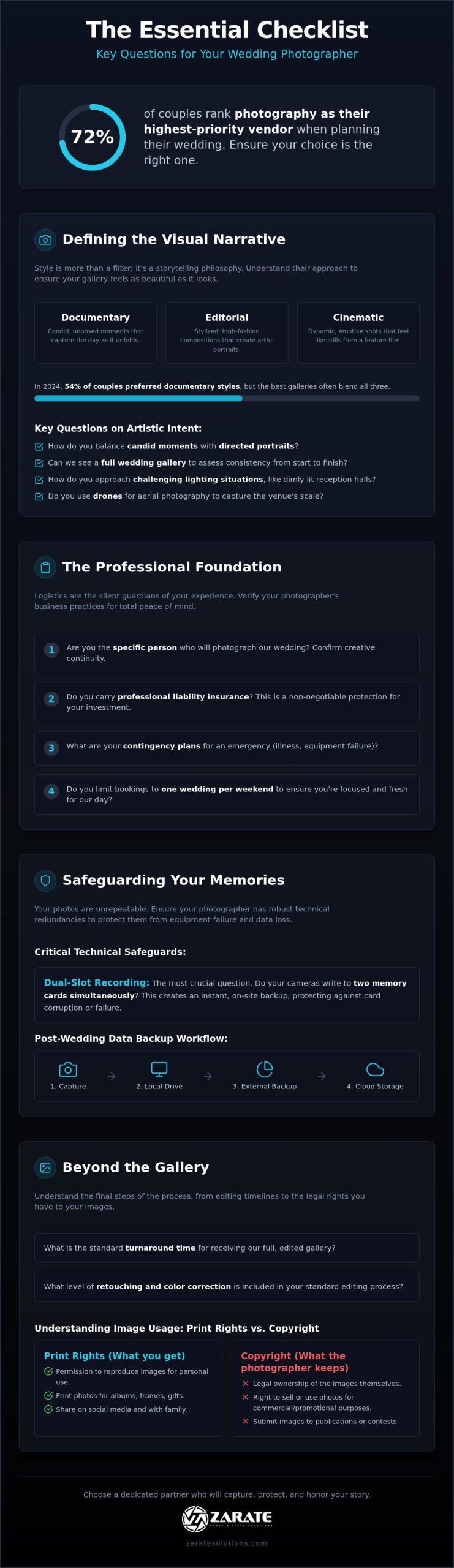
Did you know that 72% of couples rank photography as their highest-priority vendor when planning their celebration? This statistic highlights a deep, shared understanding that while the flowers will fade and the music will end, the visual record remains. You likely find yourself wondering how to know if a photographer is truly a professional who can handle your wedding and protect your photos. To help you master your vendor interviews, we’ve compiled the definitive list of questions to ask a wedding photographer before booking. This framework ensures you secure a partner who is as committed to technical excellence as they are to artistic beauty.
You deserve to feel confident that your files are safe, your chemistry is natural, and your pricing is transparent. It’s common to feel anxiety about technical failures or awkward posing, but the right preparation eliminates these concerns. In this guide, you’ll learn how to evaluate a photographer’s backup systems, creative approach, and professional standards to ensure your legacy is secure. We’ll walk through everything from data redundancy to drone capabilities; providing you with the clarity needed to choose a storyteller who will capture, protect, and honor your story with grace, precision, and permanence.
Key Takeaways
- Identify the essential technical redundancies, such as dual-slot recording, that protect your images from unforeseen equipment failure.
- Move beyond generic stylistic labels to understand how documentary, editorial, and cinematic approaches shape your final visual narrative.
- Utilize a strategic framework of questions to ask a wedding photographer before booking to evaluate their professionalism, experience, and artistic depth.
- Establish a clear understanding of post-production timelines and the vital distinction between print rights and full copyright ownership.
- Prioritize personal chemistry and communication standards to ensure your photographer acts as a dedicated partner throughout your wedding journey.
Defining the Visual Narrative: Questions About Artistic Intent and Aesthetic Sync
Choosing a photographer based solely on a curated Instagram feed is a risk many couples regret. Style is not a filter. It is a philosophy. While terms like “light and airy” describe a color palette, they often fail to address the underlying narrative structure of your day, leaving couples with a gallery that looks beautiful but feels hollow. When refining your list of questions to ask a wedding photographer before booking, prioritize their storytelling philosophy over their editing presets. A photographer’s eye should be discerning, intentional, and evocative.
Modern wedding narratives often blend three primary styles: documentary, editorial, and cinematic. Industry data from 2024 shows that 54% of couples preferred documentary or photojournalistic styles, yet the most enduring visual legacies often incorporate high-fashion editorial compositions as well. You should ask how they weave these together to form a cohesive whole. For a truly comprehensive perspective, inquire about their use of specialized drone photography to capture the scale and atmosphere of your venue from above. This aerial vantage point adds a layer of sophistication that traditional ground-level shots cannot replicate; providing a sense of place and grandeur that ground-level photography lacks.
The Philosophy of the Shot
Understanding how a professional interacts with your environment is crucial for your comfort. Ask: “How do you balance candid moments with directed portraits?” A skilled artist knows when to blend into the background and when to step forward to refine a pose. You should also inquire about the specific emotions they strive to capture. Are they looking for joy, solemnity, or the subtle tension of anticipation? If they have experience in cinematic wedding videography, ask how that discipline informs their still photography. This cross-disciplinary expertise often results in images that feel more dynamic, rhythmic, and alive. Their goal is to observe, document, and elevate your personal history.
Portfolio Depth and Consistency
A “best-of” highlights reel can be deceptive. You must ask to see a full gallery from a single wedding to verify their consistency across an entire day. Pay close attention to how they handle the visual transition between a sun-drenched outdoor ceremony and a dimly lit indoor reception. Inquire about their specific approach to diverse lighting environments, especially if your venue features challenging elements like high ceilings or colored uplighting. A true professional remains adaptable, prepared, and composed regardless of the technical hurdles presented by the architecture or the hour. This consistency ensures your legacy remains high-quality from the first look to the final dance.
The Professional Foundation: A Checklist for Logistics and Experience
Logistics often feel secondary to the romance of the day, yet they are the silent guardians of your experience. A professional foundation ensures that your memories are captured with precision, reliability, and respect. When developing your personal list of questions to ask a wedding photographer before booking, you must look beyond the camera lens to the business structure itself. Verifying business legitimacy, such as professional liability insurance, is a non-negotiable step in protecting your investment and your peace of mind. These details provide the security necessary to let you focus entirely on the celebration.
Operational Reliability
Trust is built on transparency. You must confirm that the artist you interview is the same person who will hold the camera on your wedding day. Some larger agencies operate as high-volume studios, but a bespoke service prioritizes individual connection and creative continuity. Ask about their specific contingency plans for equipment failure or personal emergencies. A true professional carries multiple camera bodies, redundant lenses, and ample power supplies to every event. Additionally, inquire about their booking density. A photographer who limits their schedule to one wedding per weekend can offer a level of focus, energy, and dedication that a high-volume studio simply cannot match.
Venue and Team Integration
Your wedding is a complex choreography of vendors. A photographer must be a collaborative partner, not a solitary actor. Ask if they have worked with your specific planner or venue, as familiarity with the layout and lighting can significantly streamline the day. It is equally vital to understand how they coordinate with the videography team to avoid being in each other’s shots. Professional synergy ensures that neither party obstructs the other’s work, resulting in a harmonious visual record. Some artists require a site visit or a walkthrough prior to the date to identify the best vantage points and lighting opportunities. This meticulous preparation is what separates a standard service from a premium experience. If you are seeking a partner who values this level of detail, exploring refined wedding photography options will help you find a professional who treats your event with the gravity it deserves. Contractual clarity regarding everything from the morning preparations to the grand exit ensures your legacy remains undisturbed by logistics.
Safeguarding the Unrepeatable: Questions on Technical Redundancy and Data Security
Artistic brilliance is the soul of your wedding gallery, but technical security is its skeleton. Without a robust archival strategy, the most breathtaking portraits remain vulnerable to the unpredictable nature of digital storage. Your wedding day is a singular event that cannot be restaged, recreated, or repeated. Consequently, your list of questions to ask a wedding photographer before booking must prioritize the safeguarding of your visual legacy. A professional who understands the gravity of preservation will have clear, documented protocols for data management from the first shutter click to the final delivery.
The industry standard for professional reliability is dual-slot recording. This means the camera writes every image to two separate memory cards simultaneously, creating an instant, real-time backup. If one card fails or becomes corrupted, the second card holds the identical file. This level of redundancy is a non-negotiable requirement for any high-end event. A photographer’s deep understanding of a digital media recovery service often signals a higher level of technical literacy. They don’t just take pictures; they manage, protect, and archive your personal history with meticulous care.
On-Site Redundancy
Preparation begins long before the ceremony starts. You should ask your photographer about the specific volume of equipment they bring to ensure coverage never falters. A standard kit should include at least two professional-grade camera bodies and a diverse array of lenses to handle any lighting or spatial challenge. Inquire if they back up their memory cards to a portable drive or a laptop before they even leave the venue. This practice creates a third layer of security, ensuring that your photos are safe even before the drive home begins. Reliability is found in the details of their hardware and the discipline of their workflow.
Post-Wedding Archiving
The journey of your images continues well after the final dance. Ask about their long-term storage policy and whether they maintain an off-site or cloud-based backup of your final high-resolution files. Digital files are susceptible to bit rot, hardware failure, and accidental deletion. A professional archivist uses a multi-tiered approach: local storage, physical off-site drives, and encrypted cloud servers. Understanding these protocols allows you to rest easy, knowing your investment is protected against the passage of time and the fragility of technology. This technical rigor is what transforms a simple vendor into a lifelong guardian of your memories.
The Collaborative Dynamic: Evaluating Chemistry and Communication
Your wedding photographer is the one vendor who remains by your side from the first application of makeup to the final departure. Because of this constant proximity, personality “fit” is not merely a preference; it is a prerequisite for authentic imagery. When refining your questions to ask a wedding photographer before booking, you must look for a partner who can navigate high-pressure moments with grace and composure. A photographer who understands your personality can anticipate your reactions, soothe your anxieties, and capture your most genuine expressions. This emotional intelligence is what transforms a standard gallery into a profound personal history.
Communication and Planning
Clear communication is the bedrock of a seamless planning experience. You should ask: “How do you help us feel natural and comfortable in front of the lens?” This question addresses the common fear of looking stiff or staged. A professional uses a blend of gentle direction, observational patience, and technical expertise to elicit movement and emotion. Inquire about their preferred communication frequency and how they manage “must-have” shot lists. While you want your vision honored, a skilled artist will also explain how a rigid list can sometimes stifle the spontaneous, unrepeatable moments that define a documentary style. They should act as a guide, helping you prioritize the moments that carry the most emotional weight.
Managing the Wedding Day Energy
A wedding day is a living, breathing entity with its own rhythm and occasional friction. Ask your photographer to describe their presence: are they a “fly on the wall” or a proactive director? Both have merit, but their style should align with your desired atmosphere. You must also understand how they handle stressful timeline delays or inclement weather. Can they pivot quickly? Do they remain calm when family dynamics become complex? Ask for specific examples of how they’ve managed large wedding parties or coordinated with videographers to ensure a harmonious workflow. This synergy is essential for a cohesive visual legacy. If you are ready to find a storyteller who balances technical precision with a calming, professional presence, book a consultation with our photography team today.
Consider the engagement session as a vital “dry run” for your wedding day. It provides a low-stakes environment to build rapport, practice posing, and refine your visual language before the main event. This collaborative foundation ensures that when the wedding day arrives, you aren’t working with a vendor, but with a trusted partner who already knows how to make you shine. A successful partnership is built on trust, shared vision, and mutual respect.
Beyond the Gallery: Questions About Post-Production, Rights, and Your Legacy
Your wedding day concludes with a grand exit, but the journey of your visual legacy is only beginning. The final phase of your collaboration involves the transformation of raw moments into a polished, curated narrative. When finalizing your list of questions to ask a wedding photographer before booking, you must look beyond the initial delivery of a digital link. A true archivist considers how your story will be told, shared, and preserved for generations, ensuring your investment retains its emotional and technical value over time. This stage is where your raw history is refined into a lasting work of art.
Editing and Deliverables
Turnaround times are a common point of anxiety, so you should ask for a specific commitment regarding the delivery of your final gallery. Most established professionals in 2026 aim for a window of 4 to 8 weeks, though many provide a “sneak peek” within days of the celebration. Inquire about the expected image count for your specific coverage hours. An 8-hour day typically yields between 400 and 800 meticulously edited images. You should also understand why most professionals decline to provide “RAW” unedited files. These files are the digital negatives; they lack the color grading, exposure refinement, and artistic vision that define a photographer’s signature style. Integrating drone photography for events into the final edit ensures that these aerial perspectives are harmonized with the ground-level shots for a seamless, cinematic experience.
Long-Term Accessibility
Clarifying your rights is a vital step in the booking process. You must distinguish between “Print Rights” and “Copyright Ownership.” While the photographer generally retains the copyright, you should ensure you have the right to print your photos at a lab of your choice. This prevents you from being tethered to a single proprietary gallery system. Beyond digital storage, ask about physical heirloom albums or fine art prints. Digital files are convenient, yet they are susceptible to hardware failure and format obsolescence. A physical album is a tangible legacy that ensures your history remains accessible for the next 50 years. Your questions to ask a wedding photographer before booking should reflect a commitment to both immediate sharing and permanent preservation. This dual focus guarantees that your memories remain vivid, tangible, and secure for a lifetime.
Securing Your Visual Legacy
Your wedding day is a singular, unrepeatable moment in your personal history. By utilizing a comprehensive framework of questions to ask a wedding photographer before booking, you move beyond surface-level aesthetics to ensure a partnership built on trust, transparency, and technical excellence. You’ve now gained the clarity to evaluate dual-slot recording, cinematic drone perspectives, and essential contractual protections. These elements combine to safeguard your investment from the risks of data loss, creative misalignment, or logistical confusion.
Choosing an artist is a profound declaration of what you value most about your past and your future. At Zarate Photo & Video Solutions, we serve as both bespoke storytellers and technical experts in media preservation. Our team bridges the gap between high-end artistic creation and rigorous data recovery standards; ensuring your memories remain vivid, accessible, and safe. Secure your wedding legacy with Zarate Photo & Video Solutions to experience a level of craftsmanship that honors the gravity of your story. Your history is worth protecting, and we’re here to ensure it remains a vibrant part of your family narrative for decades to come.
Frequently Asked Questions
How much should I expect to pay for a professional wedding photographer in 2026?
Industry data for 2026 suggests most couples spend between $2,500 and $7,000 on their wedding photography. This investment typically covers the artist’s experience, regional location, and the specific length of coverage. While luxury editorial photographers can exceed $10,000, the national average often falls between $3,000 and $4,500. It’s essential to consider these figures as industry benchmarks rather than fixed rates, as technical security and expertise often command a premium.
Do I really need a second photographer for my wedding?
A second photographer is highly recommended for events with large guest counts or complex logistics. This additional professional captures alternative angles, guest reactions, and simultaneous moments, such as both partners getting ready in separate locations. Industry rates for adding a second shooter typically range from $500 to $1,500. Having a second lens ensures a more comprehensive narrative and provides an extra layer of security during critical, unrepeatable moments.
What happens if my wedding photographer gets sick on the big day?
Professional photographers maintain a robust network of peers and a clear contingency plan within their contract. If an emergency occurs, they should provide a replacement with a similar artistic style and professional caliber. This is one of the most critical questions to ask a wedding photographer before booking to ensure your day is protected. A reputable studio will handle the substitution logistics, ensuring your visual legacy remains a priority.
How long does it typically take to receive wedding photos?
You can generally expect to receive your final edited gallery within 4 to 8 weeks after the celebration. While the anticipation is high, this window allows for the meticulous color grading and curation required for high-end storytelling. Many professionals provide a “sneak peek” of selected highlights within a few days to satisfy immediate sharing needs. Digital galleries are the standard delivery method for 94% of couples, offering easy access and security.
Should I give my photographer a shot list of every single photo I want?
While a list of essential family groupings is helpful, providing a granular shot list for every moment can actually hinder creative flow. Professionals excel at capturing spontaneous, unscripted emotions that a rigid checklist might miss. Instead of a literal list, discuss your visual priorities and “must-have” people. This collaborative approach allows the photographer to document the day authentically while ensuring the most significant figures and details are included.
Is it worth paying for an engagement session if we already have photos?
An engagement session is an invaluable experience that builds essential rapport between you and your photographer. It allows you to become comfortable in front of the lens and refine your visual language before the high-pressure environment of the wedding day. Most industry packages offer these sessions for an additional $300 to $800. This preparation ensures that when your wedding arrives, the process feels natural, relaxed, and tailored to your unique dynamic.
Can I ask my photographer to give me the unedited RAW files?
Most professional photographers do not provide RAW files because these unedited digital negatives are unfinished works. The editing process is a fundamental part of the artist’s signature style and brand identity. Providing unfinished files would be akin to a chef serving a raw steak. Instead, focus on the quality of the final, high-resolution JPEG images, which are fully polished, color-corrected, and ready for your heirloom albums or fine art prints.
What is the difference between a “sneak peek” and the full gallery?
A sneak peek is a small, curated selection of images delivered shortly after the wedding, while the full gallery is the complete, high-resolution collection. The sneak peek allows you to share highlights on social media almost immediately. The full gallery, which typically includes 400 to 800 images for an 8-hour day, represents the comprehensive narrative of your celebration. Both are essential components of a modern, professional photography experience in 2026.